

What if I told you that most content calendars are little more than digital junk drawers? They are what I love to call “a collection of good ideas” and “trending topics” scheduled to fill a void. In our current market, where consumers pay more attention to what they consume than ever, “consistent posting” is no longer a competitive advantage; it is the bare minimum. The real differentiator is intent.
If your editorial process begins with “What should we write about this week?” instead of “What does the data say our audience needs to solve?” you are likely burning your marketing budget… or just drifting with time.
The shift from a reactive schedule to a data-driven content calendar is the difference between Vanity metrics and actual revenue. This guide outlines the exact framework we use to transform content from a cost centre into a predictable growth engine.
What Is a Data-Driven Content Calendar?
A data-driven content calendar is a strategic roadmap that uses historical performance, search intent data, and audience behaviour analytics to dictate every piece of content produced.
While a traditional calendar focuses on cadence (when we post), a data-driven calendar focuses on outcome (why we post).
- Traditional: Based on internal assumptions, “gut feelings,” and creative whims.
- Data-Driven: Based on CRM insights, keyword difficulty, conversion pathways, and customer pain points.
In short, it’s a system in which every tag and social caption is backed by a measurable, testable, and optimisable hypothesis. Guesswork is the silent killer of ROI; data is the antidote.
Why Most Content Calendars Fail
The reason 90% of content fails to generate leads isn’t a lack of quality; it’s a lack of alignment. Most teams fall into these traps:
- Ignoring Search Intent: Creating “educational” content for users who are actually in the “decision” phase, or vice-versa.
- Vanity Metric Obsession: Celebrating 10,000 views on a blog post that has a 0% conversion rate because it attracted the wrong audience.
- No Defined KPIs: If you don’t know what “success” looks like before you hit publish, you can’t optimise for it.
- Zero Revenue Alignment: Content that exists in a vacuum, disconnected from the sales team’s needs or the product roadmap.
- Static Planning: Setting a six-month calendar and refusing to pivot when the data shows a specific topic is underperforming.
The 7-Step Framework That Works Like Magic
To build a high-performance content calendar strategy, you need a repeatable system. This seven-step framework will help you ensure that every piece of content you create serves your bottom line.
Step 1: Define Business Objectives
Before looking at keywords, look at your P&L. Content should be a servant to your business goals.
- Lead Generation: Focus on gated assets and bottom-of-funnel (BOFU) case studies.
- Brand Authority: Focus on original research and thought leadership.
- Customer Retention: Focus on “How-to” guides and feature updates for existing users.
- Actionable Insight: Assign one primary business objective to every month on your calendar.
Step 2: Analyse Audience Data
Your best data doesn’t come from a tool; it comes from your customers.
- CRM Insights: What questions are leads asking your sales reps?
- Website Analytics: Which pages have the highest “Time on Page” but the lowest bounce rates?
- Social Insights: Which topics spark actual conversation rather than just passive likes?
Use these inputs to build a “Problem-Solution” matrix for your target personas.
Step 3: Conduct SEO & Keyword Research
SEO content planning is about finding the intersection of high volume, low difficulty, and high intent.
- Identify High-Intent Topics: Don’t just chase volume. A keyword with 500 monthly searches and “High” commercial intent is worth more than a “What is…” keyword with 10,000 searches.
- Map to Funnel Stages: Categorise your keyword list by informational, navigational, and transactional intent.
Step 4: Audit Existing Content
Don’t reinvent the wheel if you already have a flat tyre. Use a content audit to decide if you want to:
- Keep: High-performing content that needs no change.
- Update: Content that is ranking on page 2 or has outdated data.
- Consolidate: Three short posts on the same topic that should be one “Power Page.”
- Delete: Content that attracts the wrong audience or is no longer relevant.
Step 5: Map Content to the Funnel
A balanced content marketing strategy ensures you are not ignoring any part of the buyer’s journey.
| Funnel Stage | Content Type | Goal |
| Awareness (TOFU) | Infographics, Trends, Broad Guides | Brand reach & Traffic |
| Consideration (MOFU) | Comparison Guides, Webinars, Templates | Lead Capture |
| Decision (BOFU) | Case Studies, Product Demos, Pricing | Sales Conversion |
| Retention | Product Updates, Loyalty Content | LTV Expansion |
Step 6: Assign Metrics That Matter
Move beyond “Sessions” and “Likes.” To prove content ROI, you must track:
- Conversion Rate per Post: How many people signed up for a newsletter or demo from this specific page?
- Scroll Depth: Are they actually reading, or just clicking?
- Assisted Conversions: Does this blog post appear in the touchpoint path of a closed deal?
Step 7: Build a Repeatable Reporting System
Data is useless if it is not reviewed. Establish a “Monthly Content Sprint”:
- Review: Analyse last month’s winners and losers.
- Hypothesise: Why did the winner win? Why did the loser lose
- Adjust: Swap out underperforming upcoming topics for variations of the winning theme.
- Test: A/B test your CTAs or headlines on high-traffic posts.
The Visual Framework: The Data-Content Loop
Imagine a circle rather than a linear path:
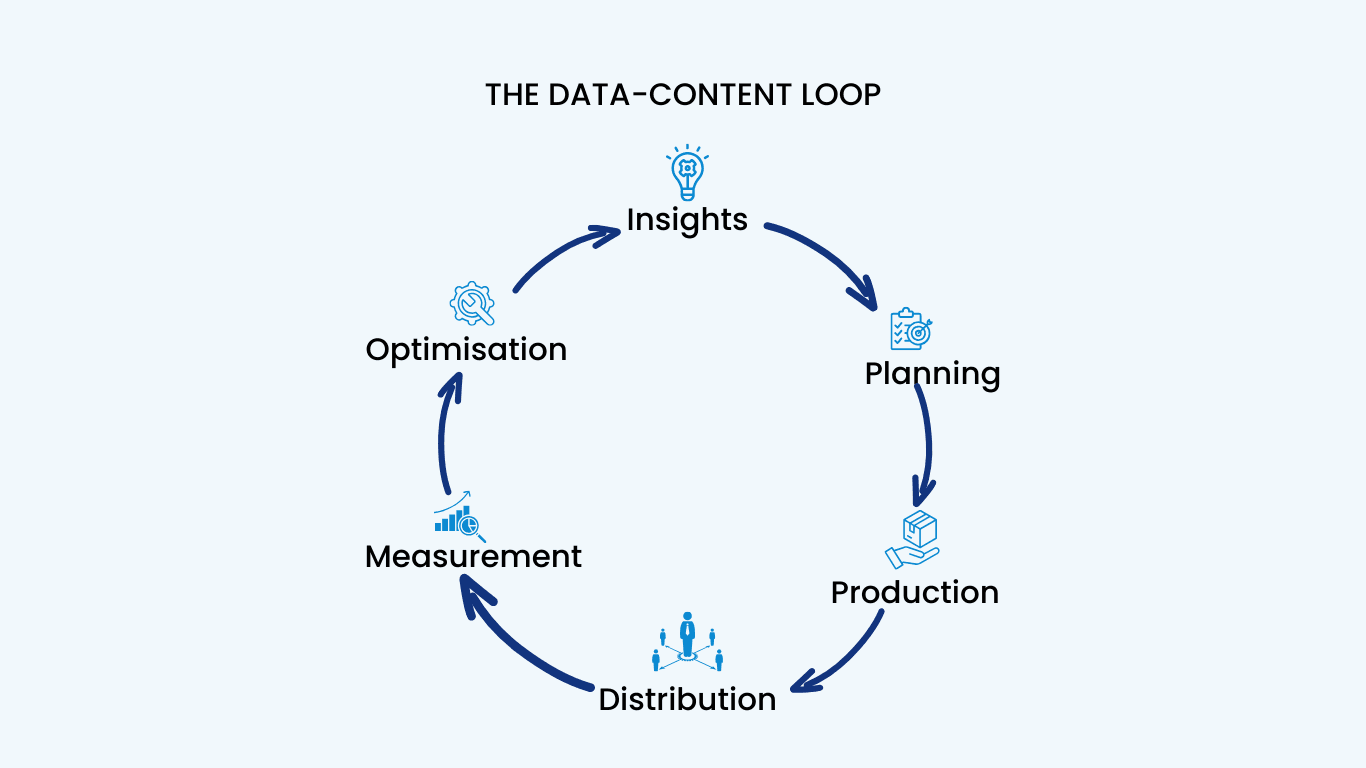
If your process stops at “Distribution,” you are leaving 50% of your potential growth on the table.
Real-World Case Study: How Piggyvest Used Strategic Content to Drive 40,000+ Downloads
To understand the power of a data-driven content calendar, let’s take a look at how Piggyvest, Africa’s leading online savings and investment platform, uses this simple framework to scale.
The Challenge: Beyond Generic Financial Advice
In a competitive Nigerian fintech landscape, generic “how to save money” content is background noise. Piggyvest needed to move from being a utility tool to a trusted lifestyle brand. Their strategy shifted from publishing broad financial tips to creating high-intent, culturally resonant content series based on deep audience insights.
The Strategy: Data-Led Storytelling
Piggyvest’s content team, led by strategists like Tobe Okoh, identified that their audience responded most to relatability and transparency. They launched two data-backed pillars:
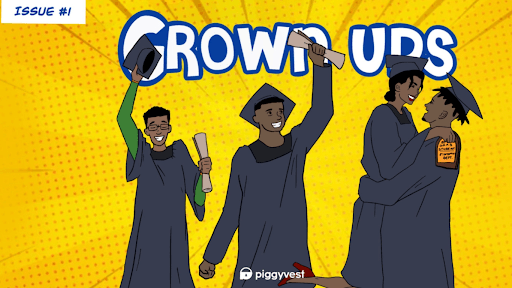
“Grown Ups”: A comic and blog series that utilised audience data regarding common financial pain points (debt, black tax, and adulting) to tell visual stories from a Nigerian perspective.
“MyPiggyvest”: A user-spotlight series that leveraged social proof and real customer success data to build trust, a critical metric in fintech.
The Results:
By moving away from “blanket” content and using a targeted, intent-mapped calendar, Piggyvest achieved:
- Customer Acquisition: Over 40,000 app downloads directly attributed to the “Grown Ups” series.
- Trust & Retention: Significant growth in user-generated content and brand sentiment, which helped scale their user base to over 4.5 million.
- High-Intent Conversion: Content that addressed specific life events (e.g., saving for rent or tuition) saw a higher conversion rate than generic educational posts.
Key Takeaway: Piggyvest didn’t just post more; they posted what the data showed was missing in the market: relatability.
Common Mistakes to Avoid
- Over-planning without testing: Don’t lock in a 12-month calendar. The market moves too fast.
- Ignoring search trends: Seasonal shifts can make or break a campaign.
- Not refreshing old content: It is often cheaper to update an old post than to write a new one.
- Publishing without distribution: If you spend $1,000 on a post, spend at least $200 (or 5 hours) making sure people see it.
Conclusion: The era of “guess and check” is over.
In 2026, the volume of AI-generated noise is staggering. To stand out, your content must be more than “good.” It must be strategically precise. Data-driven marketing isn’t a luxury for enterprise brands; it is a survival tactic for anyone serious about growth.
African marketers and brands that master the art of the data-driven calendar will consistently outperform competitors who are still relying on “gut feel.” Stop guessing what your audience wants. The data is already telling you; you just need to listen.
Ready to stop shouting into the void?
If your content isn’t directly contributing to your pipeline, it’s time for a pivot. We help growth-focused brands audit their editorial systems and build high-performance content engines. Book a content strategy audit with our team today to turn your data into a competitive advantage.
Subscribe to Our Newsletter
Start turning data into a decisive advantage and stay ahead of the curve with our weekly insights on African customer trends, marketing analytics, and market forecast delivered right to your doorstep. Subscribe here!