

The tourism sector has become one of Africa’s more reliable growth stories in the last two years. According to UN Tourism’s World Tourism Barometer, the continent recorded 74 million international arrivals in 2024, a 12% increase on 2023 and, notably, 7% above 2019 levels. That was the first time since the pandemic that Africa’s arrivals exceeded their pre-COVID benchmark. Growth continued into 2025: UN Tourism’s year-end data put Africa’s arrivals at 81 million, an 8% increase, led by North Africa at 11%.
Morocco alone drew 17.4 million visitors in 2024, making it the continent’s most-visited destination. Egypt (up 20 to 21%), The Gambia (up 46% in 2024) and South Africa (growth of roughly 19% through November 2025) posted some of the fastest expansion rates on the continent.
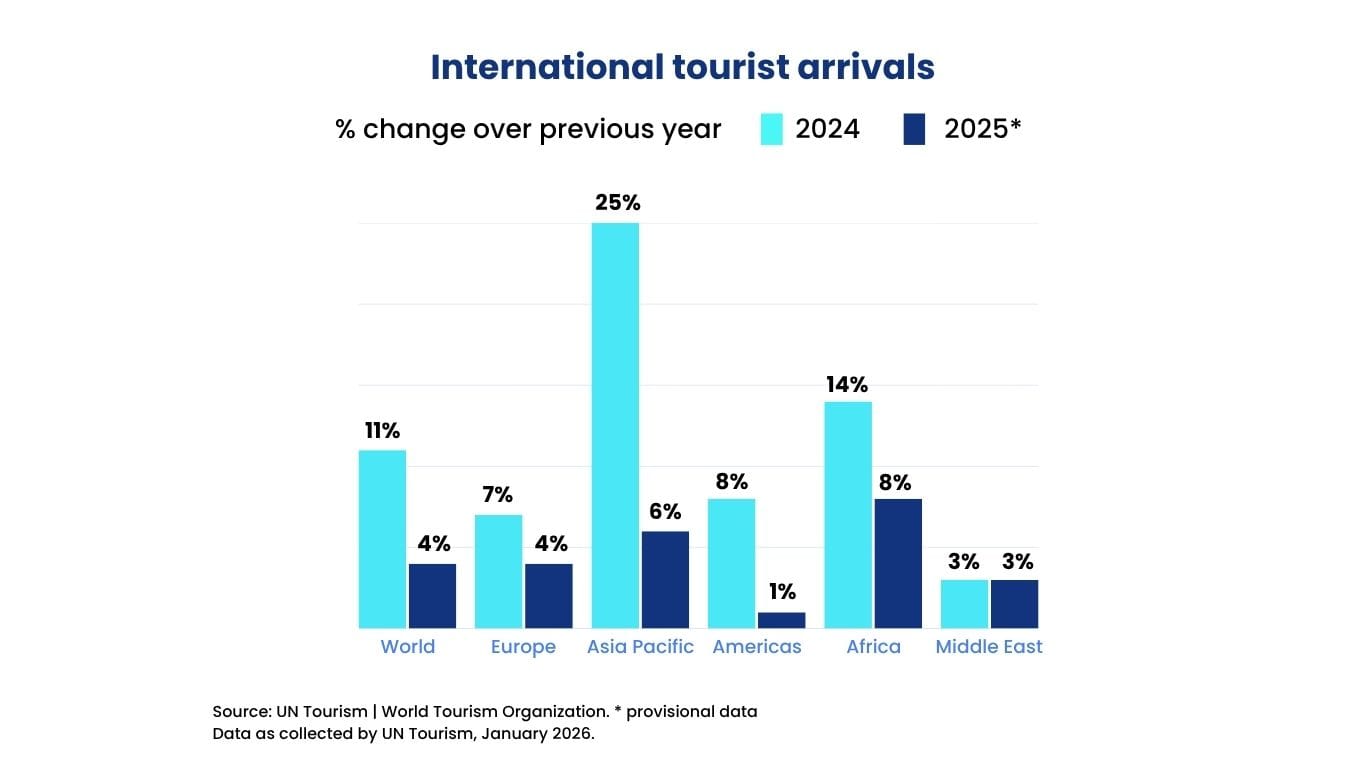
North Africa, driven by Morocco and Egypt, has recovered fastest and now anchors much of Africa’s headline numbers. Sub-Saharan markets show more mixed performance: while Namibia’s arrivals fell by close to 7% in 2025, South Africa’s grew by double digits over the same period.
That unevenness matters for anyone assessing commercial opportunity. Africa is not one tourism market. It is more than fifty distinct national markets, each with its own infrastructure, currency regime, visa policy and consumer base.
The economic footprint behind these arrivals is substantial, though some of it comes from forecasts rather than confirmed results, and the two should not be treated as equivalent. The World Travel & Tourism Council (WTTC) estimated that Travel & Tourism would contribute around $168 billion to African GDP by the end of 2024 and support roughly 18 million jobs across the continent.
That sits within WTTC’s separate, longer-range projection that the sector could create close to 14 million net new jobs across Africa over the following decade, a forecast rather than a measured outcome.
Two structural forces will shape where this growth goes next.
The first is air connectivity. The African Development Bank-backed Single African Air Transport Market (SAATM) has helped enable 108 new intra-African air routes between September 2022 and April 2025. However, the reform remains a work in progress, and airfares across the continent remain high relative to distance flown.
The second is mobility policy. The AfDB and African Union’s 2025 Africa Visa Openness Index found that only 28.2% of intra-African travel scenarios are now visa-free. In a sign of how uneven progress has been, the share of travel scenarios requiring visa formalities before departure actually rose, from 47.1% in 2024 to 51.1% in 2025. Ethiopian Airlines CEO Mesfin Bekele made the point plainly at a 2026 AfDB/African Union symposium: aviation connectivity and visa liberalisation need to advance together, because neither works at full potential without the other.
For businesses evaluating the region, this is a useful signal. Tourism demand is running ahead of the infrastructure and policy environment meant to support it, and that gap is often where adjacent commercial opportunities emerge.
Read also: Beyond the Airline
Why “tourism” is a narrow frame for the opportunity
The conventional way of sizing the African tourism opportunity is to look at hotel pipelines, airline capacity and tour operator revenues. That frame understates the real opportunity. Every additional international or domestic trip triggers a chain of transactions well beyond the flight and the hotel room: a currency exchange or card payment, a ride from the airport, a mobile data purchase, a restaurant meal, an insurance policy, a retail purchase, a booked activity, and dozens of smaller digital interactions such as reviews, bookings and translation apps that never touch an airline or a hotel’s balance sheet at all.
This is the wider ecosystem view. Tourism acts as a demand multiplier that reaches into payments, telecommunications, logistics, insurance, food and beverage supply chains, retail, entertainment and increasingly data and software.
Over the next decade, some of the businesses best positioned to benefit from Africa’s tourism growth may not be travel companies at all. They may be fintechs, insurers, logistics operators, telecom providers and software vendors that treat travellers as a high-value, high-frequency customer segment moving through their existing product lines.
Specific opportunities across the ecosystem
Digital payments and fintech infrastructure for travellers

The need: International and domestic travellers routinely struggle with currency conversion, card acceptance gaps, and the cash dependence of much of Africa’s informal tourism economy, including taxis, markets, small guesthouses and street vendors. Merchants, in turn, need affordable and reliable ways to accept payment from visitors using different payment rails than their usual local customers.
Why now: Mobile money has become Africa’s dominant financial rail. GSMA’s State of the Industry Report on Mobile Money 2026 found that sub-Saharan Africa processed $1.4 trillion in mobile money transactions in 2025, 66% of global transaction value, across more than 1.2 billion registered accounts. That scale creates an obvious interoperability opportunity: linking international card and wallet systems with domestic mobile money rails such as M-Pesa, MTN MoMo, Airtel Money and Orange Money, so travellers can pay the way merchants actually get paid.
Markets to watch: Kenya and Tanzania, home to M-Pesa and its mature merchant acceptance network; Ghana and Côte d’Ivoire, MTN MoMo strongholds; and Egypt and Morocco, where card infrastructure is more developed but cross-border remittance and tourist foreign exchange products remain underdeveloped.
Who can participate: Payment processors, cross-border switch operators, neobanks building travel-specific wallets, currency exchange fintechs, and point-of-sale hardware and software providers targeting small tourism merchants such as guesthouses, tour operators and craft markets.
Data needed before entry: Merchant payment acceptance rates by tourism sub-sector and region; transaction size and frequency patterns among inbound versus domestic travellers; regulatory requirements for cross-border money transmission in each target market; interoperability status between mobile money operators.
Barriers: Fragmented regulatory regimes country by country; interoperability gaps between mobile money operators even within the same country; currency volatility and capital controls in markets like Nigeria, Ethiopia and Egypt; low card acceptance outside major cities.
Travel insurance and health and travel-risk products

The need: Travel insurance penetration remains low relative to arrival volumes, despite rising traveller awareness of medical evacuation costs, trip cancellation risk and, in some markets, political or health-related disruption.
Why now: As middle-class African travellers increasingly book independently rather than through traditional agents, and as inbound long-haul travellers grow more risk-aware after the pandemic, insurers face an underpenetrated market. Mobile money operators are already expanding into adjacent financial products. GSMA reports that the number of mobile money providers offering insurance grew by a third in 2025, which shows distribution channels already exist and are being used for related financial products.
Markets to watch: Kenya and Nigeria, where insurtech and mobile-distributed micro-insurance are more mature; South Africa, with a larger formal insurance market and higher-value outbound and domestic leisure travel; Morocco and Egypt for inbound travel insurance tied to package tourism.
Who can participate: Insurtechs partnering with mobile money operators or online travel agencies to embed travel insurance at the point of booking; reinsurers structuring products for regional risk pools; traditional insurers building micro-policy products priced for shorter, lower-value domestic trips.
Data needed: Claims history and risk profiles by destination and traveller segment; trip duration and spend patterns; existing insurance penetration and distribution gaps; regulatory approval timelines for micro-insurance products.
Barriers: Low consumer familiarity with insurance products in some markets; thin actuarial data on African traveller risk; distribution costs for reaching informal and budget travellers.
Ground transportation, mobility and last-mile logistics

The need: Airport-to-city transfers, inter-city travel and last-mile connectivity to attractions remain inconsistent across much of the continent, particularly outside flagship cities like Cape Town, Nairobi, Marrakech and Lagos.
Why now: Rising arrivals in secondary and tertiary destinations, such as coastal towns, national parks and cultural heritage sites, are outstripping the formal transport infrastructure built to serve them. WTTC and VFS Global’s coastal tourism research projects that coastal tourism alone could contribute over $100 billion to African economies by 2030, much of it in destinations with weaker transport links than capital cities. That is a forecast, not a confirmed figure, but it illustrates the scale of the gap.
Markets to watch: Kenya and Tanzania for safari circuit logistics; Morocco for inter-city rail and road links between Marrakech, Fez and coastal destinations; Nigeria for urban ride-hailing demand in Lagos tied to business and events travel; and emerging coastal destinations in Mozambique, Senegal and Cabo Verde.
Who can participate: Ride-hailing and shuttle operators building tourism-specific fleets; airport transfer aggregators; car rental platforms adapted for cross-border use; rail and coach operators partnering with destination management organisations.
Data needed: Visitor flow patterns between airports, hotels and attractions; seasonal demand variation; existing informal transport pricing and reliability; regulatory licensing requirements for cross-border vehicle operation.
Barriers: Road infrastructure quality; fragmented licensing across borders; safety and insurance liability; competition from entrenched informal transport operators.
Hospitality and destination technology beyond property management systems

The need: Small and mid-sized accommodation providers, tour operators and attractions, which make up the bulk of Africa’s tourism supply outside a handful of international hotel chains, often lack the booking, distribution, inventory and customer relationship tools that larger operators take for granted.
Why now: Online travel agents and direct booking channels are becoming the default discovery route for both international and, increasingly, domestic travellers. Many small tourism businesses remain under-digitised, which creates a large addressable market for affordable software tools built for their scale and budget.
Markets to watch: South Africa and Kenya, which have the most mature business-to-business travel technology ecosystems; Nigeria, where a large domestic leisure and business travel market is still underserved by digital booking infrastructure; Rwanda, which is positioning itself as a conferences and exhibitions hub with strong digital government infrastructure to build on.
Who can participate: Software vendors offering booking, channel management and customer relationship tools priced for small business budgets; destination management organisations building shared digital infrastructure; data and analytics providers helping tourism boards and operators understand demand.
Data needed: Small business digital adoption rates; booking channel mix (direct, online travel agency, agent, walk-in) by market; connectivity and device access among target operators.
Barriers: Low willingness to pay among small operators; connectivity gaps in rural and remote tourism zones; competition from global online travel agencies with far larger marketing budgets.
Telecommunications and connectivity products for travellers

The need: Reliable, affordable data access is now close to a universal expectation among travellers, for navigation, payments, translation, ride-hailing and social sharing. Yet international roaming remains expensive, and eSIM or local SIM adoption among inbound travellers is inconsistent.
Why now: As digital payment and booking tools become central to the travel experience, connectivity is no longer a convenience but a basic requirement. Telecom operators that already dominate mobile money distribution are well placed to bundle connectivity, payments and travel services together.
Markets to watch: Kenya, South Africa and Egypt, with relatively strong mobile network coverage and growing eSIM adoption; and more connectivity-constrained but high-growth destinations such as Ethiopia and Mozambique, where the upside is largest but execution risk is also higher.
Who can participate: Mobile network operators bundling travel SIM and eSIM products; eSIM aggregators partnering with airlines and online travel agencies; telecom-fintech joint ventures extending mobile money services to inbound travellers.
Barriers: Regulatory restrictions on foreign SIM registration; network coverage gaps outside urban centres; pricing competition from global eSIM providers.
Food and beverage supply chains, retail and experiential entertainment

The need: Rising visitor numbers create demand for reliable food and beverage supply chains, retail goods such as crafts, apparel and duty-free, and curated experiences including cultural tours, adventure activities, nightlife and events. Much of this demand is currently served by informal, fragmented supply.
Why now: As destinations mature beyond a single attraction, such as safari, beach or a heritage site, toward multi-day, multi-experience itineraries, spend increasingly shifts toward food and beverage, retail and entertainment rather than accommodation alone. This pattern is well established in mature tourism markets and is now visible in destinations such as Cape Town, Marrakech and Zanzibar.
Markets to watch: Morocco and Egypt for retail and craft tourism; South Africa for wine, culinary tourism and live entertainment; Kenya and Tanzania for experience-based safari add-ons; Nigeria for urban nightlife and events tourism tied to its growing entertainment export industry, including Afrobeats music and Nollywood film.
Who can participate: Food and beverage distributors and cold-chain logistics providers serving hospitality clusters; experience marketplaces and booking platforms; event production and entertainment companies; branded retail and duty-free operators.
Data needed: Visitor spend breakdown by category (accommodation versus food and beverage versus retail versus activities); seasonality of experiential spend; supply chain reliability data for perishables in tourism hubs.
Barriers: Informal sector competition; supply chain and cold-chain infrastructure gaps outside major cities; currency and import cost pressures on retail goods.
Why demographic data alone is not enough
Many companies entering African tourism-adjacent markets still lean on basic arrival and demographic statistics, such as nationality, age and purpose of visit, because that is what is most readily available from national tourism authorities. This data answers who is arriving, but not how they behave once they are there, which is the information that actually determines commercial viability.
A sound market-entry decision requires understanding traveller motivations (leisure, business, visiting friends and relatives, diaspora tourism, conferences and events); spending behaviour and price sensitivity by category;
travel frequency and repeat-visit patterns, particularly for the large intra-African and diaspora segments; preferred destinations and how they shift seasonally; booking behaviour, including direct versus online travel agency versus agent, lead time, and device used;
digital behaviour, such as which platforms travellers research and book on, language preferences, and how social media shapes destination choice; payment preferences, including card, mobile money or cash, and which specific providers dominate a given corridor; and, importantly, unmet needs that current supply does not address, which is usually where the clearest commercial opening lies.
The gap between arrivals data and behavioural data is often where market entries fail. A payments company that knows Kenya received several million visitors last year, but does not know what share of tourism-sector transactions still happen in cash, or which mobile money provider dominates in coastal tourism towns versus Nairobi, is working with only half the information needed to size an opportunity or design a product.
Turning tourism growth into a defensible market-entry decision
Africa’s tourism growth is real, well documented by UN Tourism, WTTC and the African Development Bank, and increasingly spread beyond a handful of flagship destinations. But growth at the continental level does not translate automatically into opportunity at the level of a specific product, in a specific country, for a specific company.
The gap between the two is filled by market intelligence: demand-side research into traveller behaviour and spending, competitive mapping of who already serves a given niche, segmentation that identifies which traveller groups are underserved, and country-level regulatory and infrastructure checks.
This is the solution Marketing Analytics Africa offers to business-to-business companies, including fintechs, insurers, telecoms, hospitality technology vendors and logistics operators, that are evaluating entry or expansion into African tourism-adjacent markets.
Rather than treating the continent’s tourism growth as a single headline statistic, tailored market research, consumer insight work, competitive intelligence and market segmentation can help a company identify which specific city, corridor or traveller segment represents a viable opportunity, what the realistic addressable market is once informal competition and infrastructure constraints are accounted for, and where the practical barriers to commercialisation are likely to sit.
Ready to scale your business with real data from real African users? Let’s have a quick chat.