

Every evening at dusk, a tightly choreographed sequence unfolds above the Horn of Africa. Dozens of wide-body jets, emblazoned with green, yellow, and red tailfins, descend in rapid succession toward Bole International Airport in Addis Ababa. Inside the terminal, tens of thousands of transit passengers shoulder past one another in overcrowded concourses.
This evening rush hour encapsulates a structural shift in global travel. Home to 1.4 billion people and the world’s youngest demographic profile, Africa represents aviation’s final great frontier. Yet for decades, Africa’s sky lanes remained a paradox: fractured by protectionism, starved of capital, and dominated by legacy European carriers taking travellers through Paris, London, or Dubai just to cross neighbouring African borders.
That paradigm is now shattering. Driven by rapid urbanisation and expanding intra-African commerce, a multi-billion-dollar infrastructure arms race has erupted across the continent. At the heart of this conflict is a fierce, three-way battle for air dominance: Ethiopia is expanding its established empire, Rwanda is deploying billions in sovereign capital backed by Gulf wealth, and South Africa is staging a fierce resurgence to defend its historic gateway.
The prize is immense. But the stakes could not be higher. The nation that captures this hub position doesn’t merely gain prestige; it secures a permanent seat at the table of African economic power. Airlines spend decades optimising their networks around hubs. Once a carrier plants its flag and invests in infrastructure, the inertia is nearly impossible to overcome. While the winner will handle not just passengers, but wealth, the loser may find itself permanently relegated to a secondary player in a continent that can no longer afford to waste such opportunities.
The Reigning Heavyweight: Ethiopian Airlines’ Unstoppable Ascent
To understand the stakes of Africa’s aviation war, we must take a look at Ethiopian Airlines. While rival African flag carriers succumbed to state mismanagement, crippling debt, or outright liquidation over the last two decades, the Addis Ababa-based airline transformed into an undisputed commercial juggernaut.
Last year, Ethiopian Airlines generated $9.1 billion in revenue while ferrying 20.7 million passengers. Those numbers alone would make it a major player in any region. But what truly distinguishes Ethiopian is the velocity of its expansion.
In a single year, the airline increased its seating capacity by an astonishing 31.2% to 17 million seats. To put this in perspective, that is equivalent to adding the combined annual capacity of multiple top-tier regional carriers in a matter of months. This is not organic growth born from gradually expanding routes; this is a deliberate, methodical expansion powered by state backing and strategic foresight.
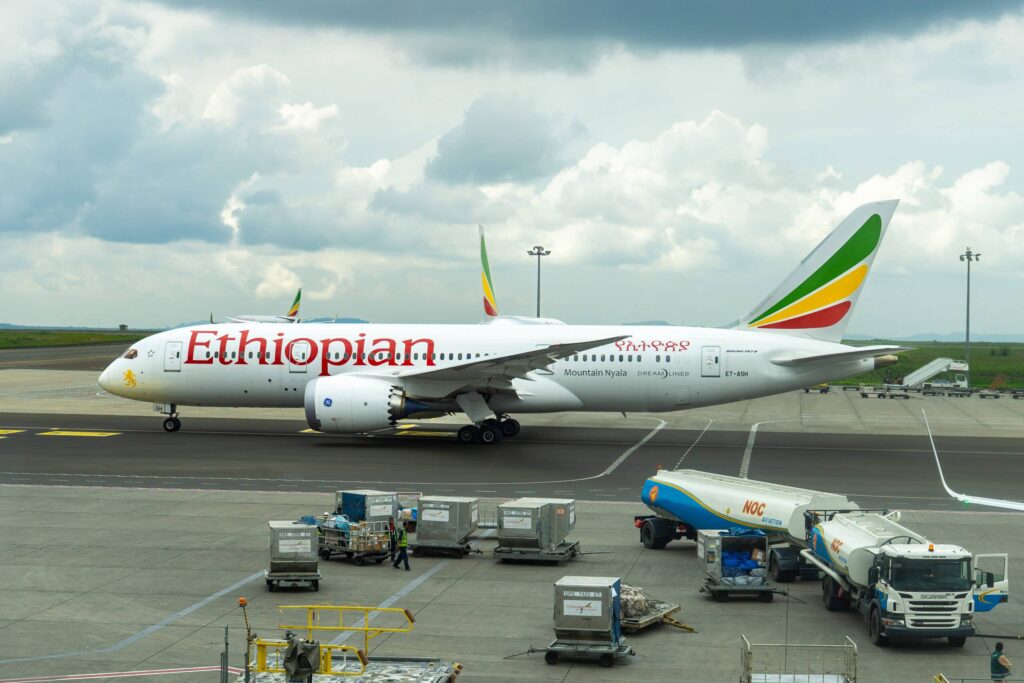
Yet the airline’s ambitions extend far beyond fleet acquisition. Ethiopian Airlines is the architect behind the Bishoftu International Airport project, a $12.5 billion undertaking that will fundamentally reshape African aviation infrastructure. Located roughly 50 kilometres southeast of Addis Ababa, Bishoftu stands as a purpose-built, state-of-the-art facility capable of handling 110 million passengers annually at full buildout. For context, that exceeds the current combined annual passenger volume of every major airport in the Southern Hemisphere.
The logic underpinning this audacious investment is both simple and compelling. Addis Ababa’s Bole International Airport, despite being Africa’s busiest hub, is geographically constrained. Bishoftu, by contrast, offers what planners call a “greenfield opportunity”: vast tracts of available land, no existing infrastructure to demolish, and room for exponential growth. Ethiopian Airlines executives envision Bishoftu as the Changi or Doha of Africa, a facility so efficient and well-designed that it becomes the inevitable choice for any passenger seeking to transit the continent.
The political establishment in Addis Ababa has thrown its full weight behind this vision. The Ethiopian government has exempted the project from standard licensing procedures and customs protocols, essentially creating a special economic zone centred around aviation. This is not a carrier building a hub around existing infrastructure; this is a nation reshaping its geography to accommodate a single carrier’s ambitions.
The Challenger in the Centre: Rwanda’s High-Efficiency Play
If Ethiopian Airlines represents the maximalist approach to hub development, then Rwanda’s strategy embodies something quite different: the art of doing more with less. Kigali’s leaders have long understood that competing directly with Ethiopia on scale would be futile. Instead, they are pursuing a more nuanced playbook: position Rwanda as the efficient, corruption-free, business-friendly alternative to Addis Ababa’s state-controlled ecosystem.
The centrepiece of this strategy is the $2 billion Bugesera International Airport, currently under construction roughly 40 kilometres south of Kigali. Unlike Bishoftu’s gargantuan 110-million-passenger ambition, Bugesera is designed with more modest initial goals: Phase 1 targets 7 million passengers annually, making it comparable in scale to a major European regional hub rather than a transcontinental megaport.

This apparent modesty obscures a shrewd calculation. Rwanda’s leadership, under President Paul Kagame, has spent three decades building a reputation for execution and efficiency that is in contrast to the bureaucratic friction that often plagues larger African economies. Bugesera will reportedly feature modern operational systems, streamlined customs procedures, and design principles borrowed from ultra-modern facilities like Istanbul’s new megaport. The implicit pitch to airlines is seductive: Why endure Addis Ababa’s congestion and political uncertainty when you can connect through Kigali with half the delays?
RwandAir, the national carrier, is deliberately positioned not as a competitor to Ethiopian Airlines but as a strategic alternative. The airline has been methodically expanding its network in Central and Southern Africa, regions where Ethiopian’s historical focus has been on the north and east. RwandAir’s fleet remains modest compared to Ethiopian, but its growth trajectory is steep, and crucially, its costs per available seat remain among the lowest in Africa.
Kigali’s ultimate wager is that in a continent increasingly sceptical of national carriers’ inefficiencies, a smaller, younger, agile competitor might prove more attractive to international airlines seeking transit partners. It’s the aviation equivalent of a startup challenging an incumbent: not by matching its size, but by out-executing it on everything else.
The Resurgent Southern Giant: Johannesburg’s Defensive Stand
If Ethiopia represents ambition and Rwanda embodies efficiency, then South Africa is playing a different game entirely: the role of the established power fighting to retain dominance. For much of the post-apartheid era, Johannesburg’s O.R. Tambo International Airport was synonymous with African aviation. It was where the continent’s wealth, and therefore its passengers, gravitated.
The pandemic nearly broke that paradigm. O.R. Tambo and South Africa’s broader aviation sector experienced the kind of contraction that suggested the old order might be in terminal decline. But something unexpected happened: recovery proved far more vigorous than sceptics anticipated. O.R. Tambo has now rebounded to roughly 18-21 million departure seats annually, a remarkable 19.6% year-on-year increase that signals the Southern African economic zone’s underlying resilience.
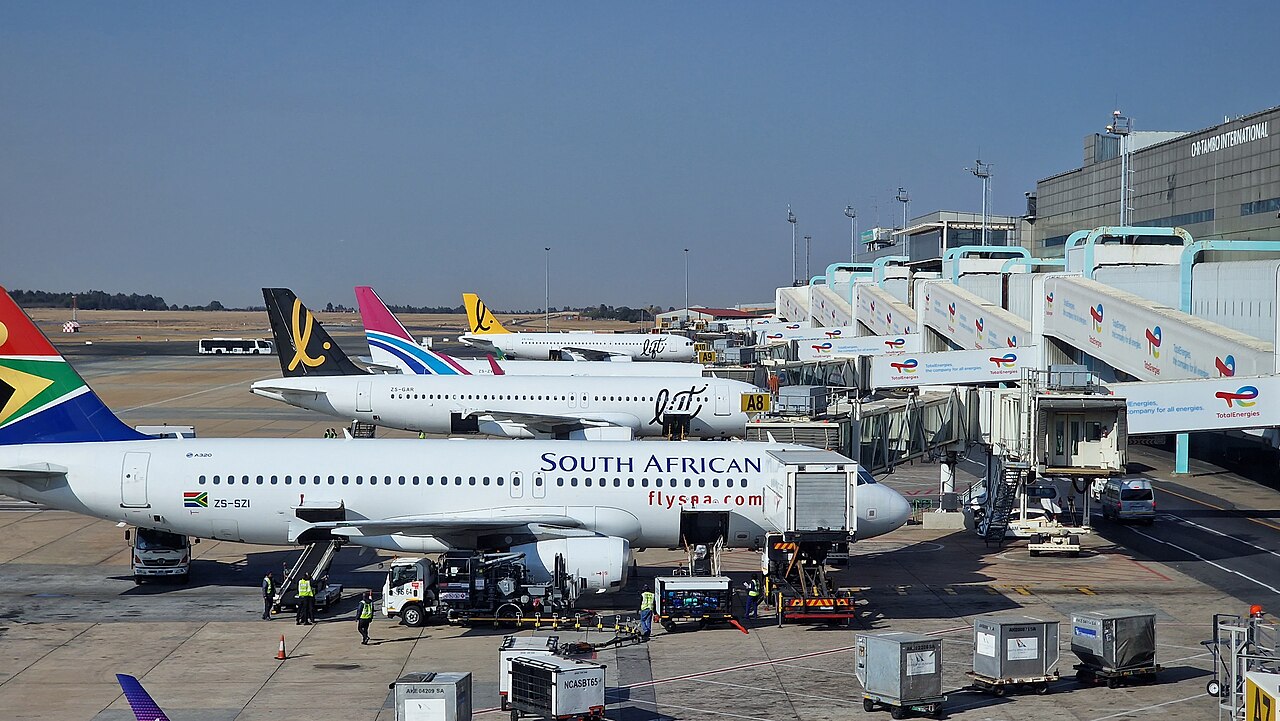
This recovery matters precisely because South Africa controls something Ethiopia and Rwanda largely lack: direct connections to the rest of the world. Johannesburg is where the long-haul routes cluster—the direct flights to London, New York, Frankfurt, and Tokyo that generate the highest-value passenger bookings. While Ethiopian Airlines dominates intra-African connectivity, O.R. Tambo retains the international connectivity that wealthy business travellers and tourists seek.
Moreover, Johannesburg benefits from what development economists call “network lock-in.” Decades of historical passenger flow have created institutional relationships between South African airport operators, local carriers, and international airlines that are extraordinarily difficult to disrupt. British Airways didn’t establish a South African hub and then staffing, maintenance, and catering infrastructure overnight; these systems took decades to construct. Shifting them elsewhere would require international carriers to shoulder massive switching costs.
South African Airways’ collapse cast a shadow over Johannesburg’s prospects, but the emergence of Airlink and flydirect South Africa has provided competition and route options that have actually helped the ecosystem adapt. Without a monopoly carrier defending legacy routes, Johannesburg’s airport has become more responsive to market dynamics.
Read also: How to Win Where Your Competitor Is Winning: 7 Key Practical Strategies To Stay Ahead
The Stakes & Conclusion: Who Will Shape Africa’s Future?
The outcome of this struggle will reverberate far beyond the aviation industry. The hub winner will exercise disproportionate influence over Africa’s integration into global trade networks. Airlines don’t merely transport passengers; they transport goods, ideas, and economic opportunity. The nation controlling the primary hub becomes the default connector between Africa’s 1.4 billion people and the rest of the world’s 7 billion.
For the average African traveller, this competition is already delivering tangible benefits. Ticket prices on key regional routes have declined as airlines jostle for position at rival hubs. Routes that once seemed economically impossible are becoming viable. The Single African Air Transport Market (SAATM), designed to liberalise aviation across the continent, has created conditions where this competition can flourish; without it, national carriers and protectionist governments would likely have prevented the kind of aggressive hub expansion we’re witnessing.
The institutional advantages each contestant brings to the competition tell different stories. Ethiopia’s advantages are political capital, state resources, and historical positioning as the geographic and political centre of Africa (hosting the African Union). Rwanda’s advantages are operational excellence, corruption-free governance, and a blank-slate airport design. South Africa’s advantages are entrenched global connectivity, technical expertise, and a wealthy regional hinterland.
If forced to handicap this three-way race, the most likely scenario is a kind of “hub duopoly” where Ethiopia and South Africa ultimately divide dominance: Addis Ababa capturing East and Central African traffic flows, while Johannesburg retains primacy in Southern Africa and long-haul international connectivity. Rwanda, in this scenario, carves out a vital role as an efficient alternative and regional connector rather than a megahub.
But disruption remains possible. The decisions made in the next three to five years could still alter the calculus entirely. What is certain is that the old certainties no longer hold. Africa’s aviation market is no longer a sleepy backwater where a single hub could assume primacy by default.
TAfrica is building the infrastructure of its future, and three nations are betting that they will be the node through which that future flows. The winner (or winners) will shape African aviation for the next half-century.
Which airline do you think will join these big players fighting over the African skies?