

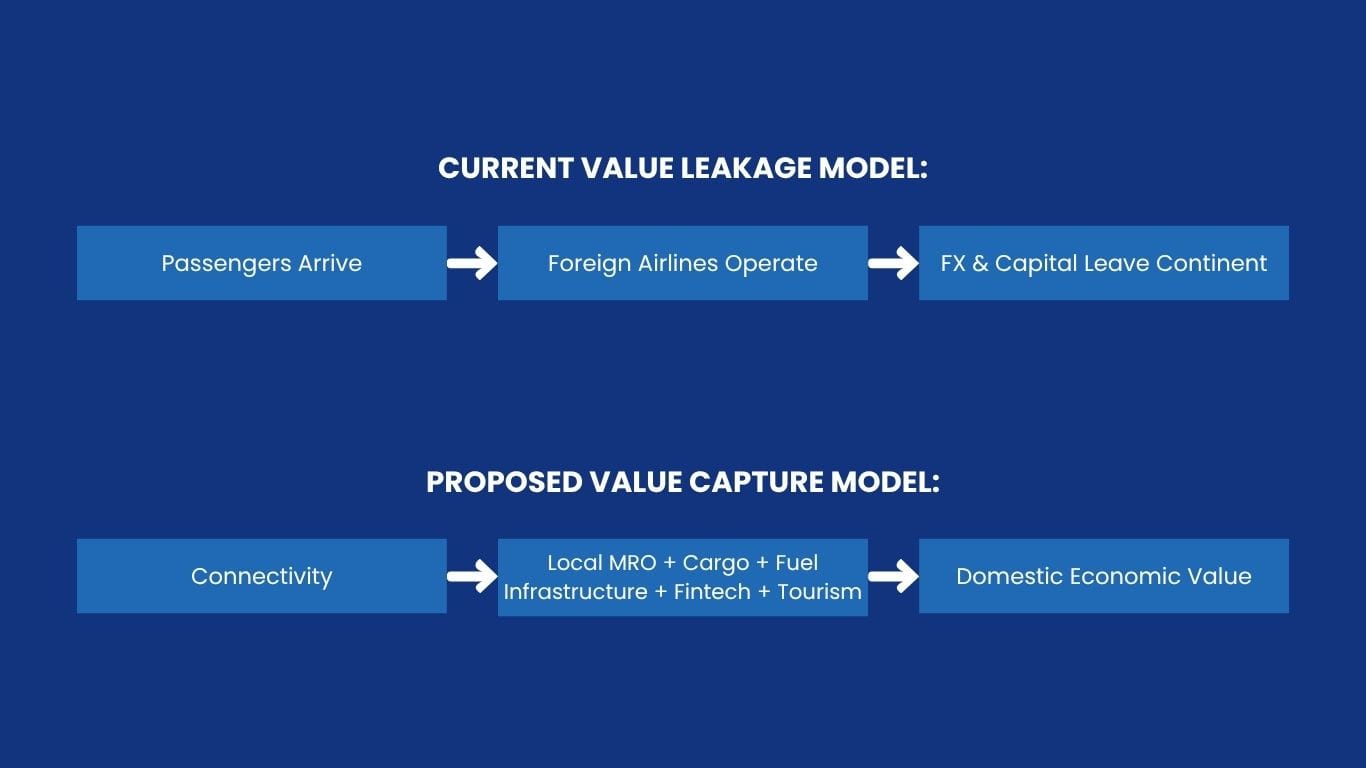
Africa can add millions of passengers, build shiny new terminals, and sign high-profile bilateral treaties, and still fail to capture the economic value of its own skyway expansion.
The standard media narrative focuses heavily on national flag carriers: fleet additions, passenger traffic milestones, and route expansions. But operating an airline is inherently a fragile, low-margin enterprise. The real economic engine of aviation is not the metal tube in the air; it is the dense web of supporting businesses on the ground.
If Africa is to convert its demographic dividend and the African Continental Free Trade Area (AfCFTA) into lasting wealth, it must pivot from an airline-centric strategy to an ecosystem-centric strategy.
The Aviation Economy Africa Is Building
According to data from the International Air Transport Association (IATA), aviation supports $75 billion in GDP and 8.1 million jobs across Africa.
The African Airlines Association (AFRAA) projects African passenger traffic to reach 113 million passengers. However, Africa’s global share of air transport remains disproportionately tiny:
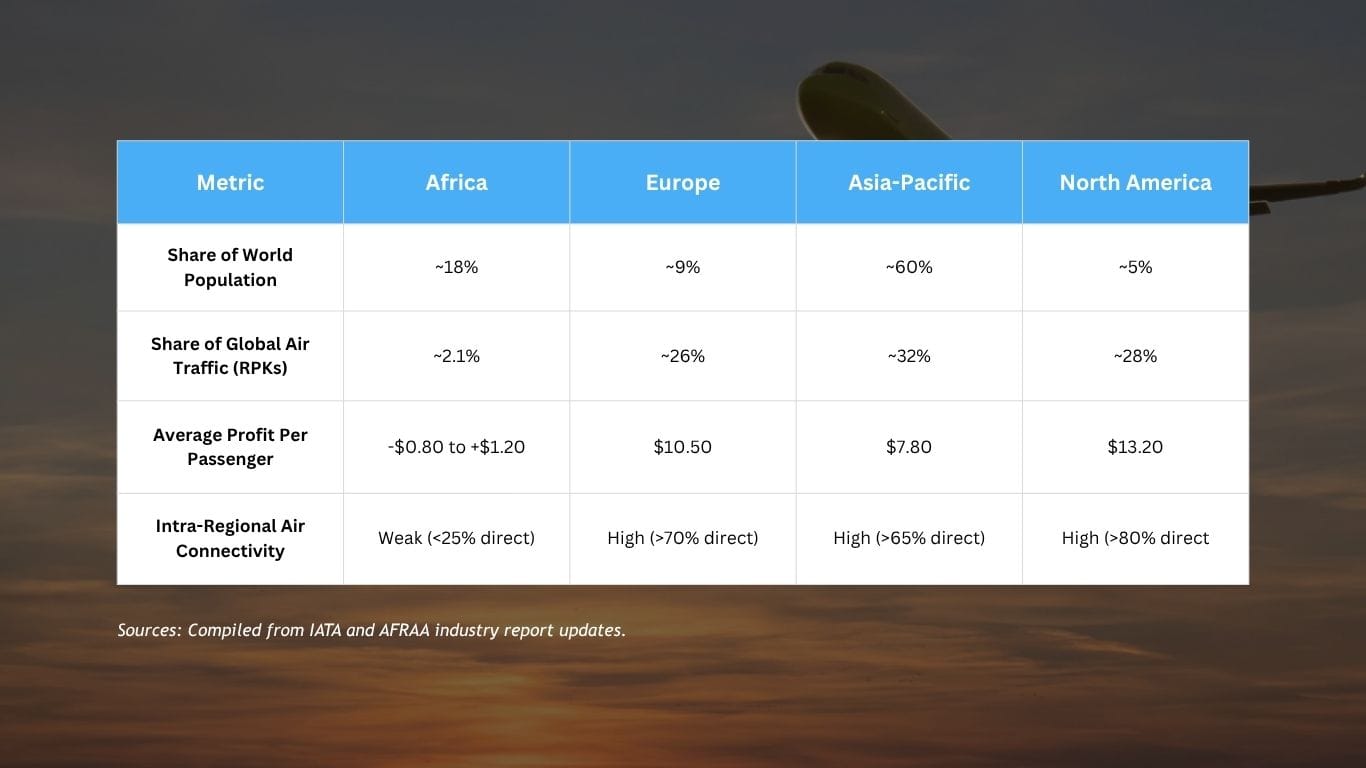
The structural gap is stark. Africa is geographically massive—capable of containing the US, China, India, and most of Europe within its borders—yet its air transport network is vastly underdeveloped for its scale.
The Paradox: More Passengers, Thin Profits
Demand for travel across Africa is rising, yet African airlines struggle to post sustainable net margins. This paradox is driven by severe cost distortions:
Inflated Jet A-1 Fuel Prices: Jet fuel accounts for 40–50% of an African airline’s operating expenses, compared to 30% globally. Poor refining capacity, inefficient supply logistics, and local monopolies inflate prices.
Foreign Exchange Exposure & Blocked Funds: Airline revenues are earned in local currencies, but leases, maintenance, insurance, and fuel are settled in US Dollars. IATA reports that as of late 2025, $1.12 billion in airline funds remained trapped across Africa and the Middle East due to FX illiquidity (notably in countries like Algeria, Ethiopia, and the XAF zone).
Fleet Age and Maintenance Penalties: The average fleet age in Africa is over 14 years (compared to ~9 years in Europe). Older aircraft burn more fuel and require frequent maintenance, which is mostly exported to Europe or the Middle East due to local MRO shortages.
The Businesses Behind the Aircraft
To capture real value, investment must flow into the specialised nodes surrounding the aircraft:
Airports and Infrastructure
Airports should not operate as passive public utility sites; they are commercial real estate platforms. Non-aeronautical revenue (retail, duty-free, real estate, logistics parks, parking) generates over 45% of global airport revenues, but represents less than 20% across most sub-Saharan airports.
Maintenance, Repair, and Overhaul (MRO)
Over 70% of heavy airframe and engine overhaul work for sub-Saharan fleets takes place outside Africa. Establishing accredited regional MRO centres retains hard currency, builds high-tech engineering capacity, and reduces fleet downtime.
Cargo and Logistics Infrastructure
Air cargo represents a key enabler of intra-African trade under the AfCFTA. However, African exports (agricultural perishables, high-value horticulture, pharmaceuticals) often spoil due to inadequate cold-chain facilities at airport cargo terminals.
Digital Payments and Travel Fintech
Cross-border payment friction, currency conversions, and high card processing fees add significant drag to travel bookings. Interoperable digital payment rails and localised travel platforms allow seamless settlement in local currencies.
What Africa Should Stop Doing
Protecting Inefficient Flag Carriers at All Costs: Siphoning public funds into loss-making state airlines to project national pride drains fiscal resources. Governments should privatize or form regional airline alliances.
Treating Aviation as a Luxury Tax Base: Levying exorbitant passenger departure fees, fuel surcharges, and navigation taxes stifles market growth.
Exporting Heavy Maintenance: Operating fleets without investing in local base maintenance capacity guarantees systemic FX capital flight.
Bilateral Protectionism: Delaying the implementation of open-skies agreements to protect domestic incumbents stifles overall economic activity.
SAATM: Africa’s Biggest Connectivity Experiment
The Single African Air Transport Market (SAATM), launched by the African Union to operationalise the 1999 Yamoussoukro Decision, aims to create a unified air transport market across the continent.
Progress remains mixed. While over 35 countries have signed up, enforcement of 5th Freedom rights (allowing an airline to fly between two foreign countries as part of a flight originating or ending in its home state) remains restricted. According to AFRAA updates, 5th Freedom operations represent only 22% of intra-African capacity, with 3rd and 4th Freedom rights controlling 78%.
Protectionism stifles competition. Broad SAATM adoption would drop fares, increase direct city-pair connections, boost intra-African trade under AfCFTA, and increase aircraft utilization rates.
Five African Lessons
Morocco: Aerospace Manufacturing & Ecosystem Building
Strategy: Developed the Midparc zone in Casablanca, offering tax incentives, tailored logistics, and targeted training.
Result: Morocco exported over $1.1 billion in aerospace components in 2024 alone, serving global OEMs like Boeing and Airbus.
Ethiopia: The Integrated Hub Engine
Strategy: Ethiopian Airlines Group integrated its airline operations with an expanded hub (Addis Ababa Bole Airport), an in-house aviation academy, MRO facilities, and a hotel chain.
Result: Addis Ababa handles over 14.7% of total regional seat capacity, creating a self-sustaining aviation ecosystem.
Kenya: Cold-Chain Cargo Infrastructure
Strategy: Investments in specialised cold-storage facilities at Jomo Kenyatta International Airport (Nairobi).
Result: Nairobi has become a primary export hub for fresh horticulture and floriculture into European and Middle Eastern markets.
South Africa: Advanced Airport Commercialisation
Strategy: Airports Company South Africa (ACSA) leveraged public-private frameworks to turn O.R. Tambo and Cape Town International into commercial real estate and retail hubs.
Result: High non-aeronautical revenues cushion ACSA against airline volatility.
Rwanda: MICE Tourism Integration
Strategy: Aligned RwandAir’s route network with investments in the Kigali Convention Centre and streamlined visa policies.
Result: Transformed Kigali into a major African hub for Meetings, Incentives, Conferences, and Exhibitions (MICE).
Where the Money Could Be Made
Commercially Viable Private Sector Opportunities:
Independent Regional MRO Hubs: Joint-venture airframe and component repair shops in West and Central Africa to service regional fleets locally.
Cold-Chain Airport Logistics: Developing temperature-controlled warehouses for pharmaceutical imports and high-value perishables.
Jet A-1 Fuel Logistics Partnerships: Aggregated fuel procurement and storage infrastructure to lower landed fuel costs.
Cross-Border Travel Fintech Platforms: Multi-currency payment gateways and FX hedging platforms tailored for African travel agencies and airlines.
Specialised Regional Aircraft Leasing Platforms: Operating lessors providing turboprop and regional jet leases tailored to African sub-scale carriers.
Aviation Training Academies: Flight simulator centres and licensed maintenance technician schools to solve the regional talent shortage.
Conclusion: Rethinking the Success Metric
The growth of African aviation should not be measured solely by passenger volume or fleet additions. The primary metric of success must be value capture: How much domestic economic value does Africa retain from every passenger, route, and tonne of cargo moving through its skies?
Building the underlying infrastructure—MRO hubs, digital platforms, cold-chain logistics, and refined fuel networks—will ensure that Africa’s aviation expansion builds long-term wealth across the continent.