

How do your customers find you for the first time?
It sounds like a simple question. Yet, for most African marketing teams, it is one of the least well-answered questions in their entire intelligence stack. Brand discovery is inconsistently tracked, rarely benchmarked, and rarely analysed across markets at a pan-African level.
That is a significant problem. Because the channels through which African consumers discover brands in 2026 are shifting rapidly, and they differ meaningfully from market to market and demographic to demographic.
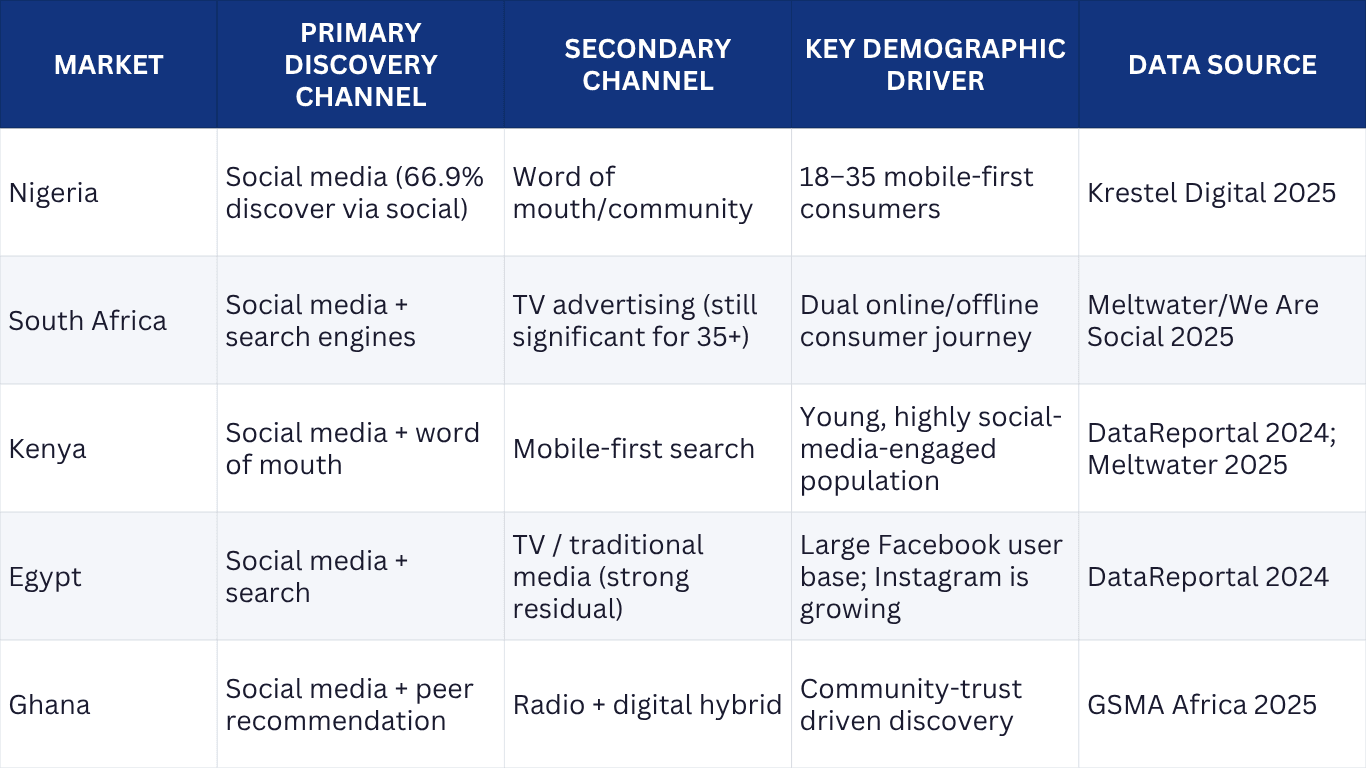
This article maps the brand discovery landscape across Nigeria, Kenya, South Africa, Ghana, and Egypt, drawing on available market-specific data to give marketing leaders at African growth-stage companies a clearer picture of where their future customers are finding brands today.
The Pan-African Brand Discovery Landscape
Brand discovery in Africa is overwhelmingly social and mobile-first. Unlike Western markets, where search engines often lead brand discovery journeys, African consumers are more likely to encounter a brand for the first time through social media content, peer recommendation, or influencer content than through search.
This distinction has significant strategic implications. A brand that invests primarily in SEO and search engine marketing as its discovery channel is optimising for a discovery pathway that may be secondary to the primary one in many African markets.
Nigeria: Social Media Is the Discovery Engine
Nigeria’s brand discovery data is the most striking on the continent. A report places Nigeria at the world’s highest rate for both social media brand discovery (66.9% of internet users) and social media product research (98.2% of internet users). These figures are not just high by African standards; they are the highest rates recorded globally.
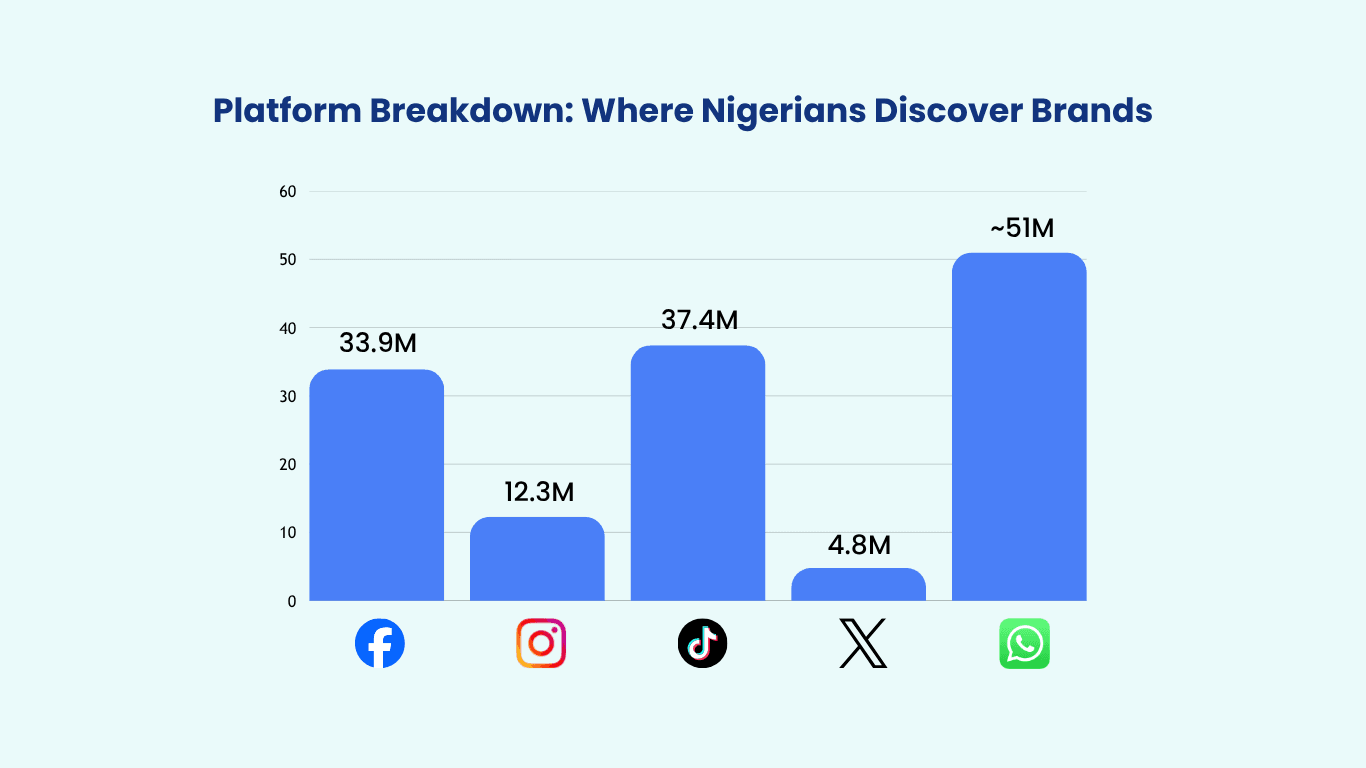
What this means in practice: for a Nigerian consumer aged 18–45, the question “heard of this brand?” is almost always answered by social media before any other channel. The discovery moment is social. The research moment is social. The validation moment, asking peers in WhatsApp groups, is also social.
The implication for brands: if you are not consistently visible and credible on Nigerian social media platforms, you effectively do not exist for the majority of your potential customers in the discovery phase.
South Africa: The Dual-Channel Discovery Market
South Africa presents a more complex brand discovery picture than Nigeria, one that reflects the country’s greater income diversity, stronger traditional media infrastructure, and higher digital maturity.
Social media remains the primary discovery channel for South Africans aged 18–34, with the country’s 26.7 million social media users spending an average of 3 hours 36 minutes per day on platforms, more than 1.5 times the global average. Within this demographic, discovery behaviour closely mirrors that in Nigeria: social-first, influence-driven, mobile-executed.
But for South African consumers aged 35 and above, television advertising retains significant discovery power. This dual-channel reality means South African brand discovery strategy requires a more sophisticated approach than simply replicating a social-first playbook.
Critically, South Africa leads Africa in e-commerce, with 10.4 million South African internet users making an online purchase in 2024 (Meltwater, 2025), creating a discovery-to-conversion pipeline that is more developed than in any other African market.
Kenya: Community and Content Discovery
Kenya’s brand discovery landscape is shaped by two distinctive forces: one of the continent’s highest rates of social media time-on-platform (behind only South Africa and Chile globally), and a strong cultural emphasis on community trust as a prerequisite for brand adoption.
With 22.17 million internet users and a 40.8% internet penetration rate (DataReportal, 2024), Kenya’s connected consumer base is younger and more mobile-first than South Africa’s. TikTok and Twitter/X are the primary discovery platforms for the 18–30 demographic. Facebook and WhatsApp remain dominant for the 30–50 segment.
What distinguishes Kenya from Nigeria and South Africa in brand discovery is the weight of community endorsement. A brand encountered through peer recommendations or community-endorsed content will have higher trust from the outset than one encountered through paid advertising.
What Pan-African Discovery Data Means for Brand Strategy
Across all five markets reviewed, three strategic implications emerge consistently:
Implication 1: Social Is the New Shelf
For consumers under 35 across all five African markets, social media is the primary channel through which they first encounter brands. A brand’s social media presence is not a marketing channel; it is the primary storefront. Brands that are not consistently visible and credible on the platforms their target demographic uses are effectively invisible at the moment of discovery.
Implication 2: Community Validation Is Part of the Discovery Funnel
Brand discovery in African markets rarely ends with a social media encounter. The next step is community validation: asking peers in WhatsApp groups, checking Twitter/X conversations, and looking at comment sections. Brands that have strong community reputations convert discovery moments into consideration. Brands that do not see high drop-off between the discovery and consideration phases.
Implication 3: Platform Mix Varies Significantly by Market and Age
A pan-African brand cannot deploy a single platform strategy across all five markets and expect consistent results. TikTok’s 56.9% user growth in Nigeria in 2025 makes it a priority discovery platform for Nigerian Gen Z. Facebook’s dominance among older Egyptians and Ghanaians makes it irreplaceable in those markets. South Africa’s dual online/offline consumer journey requires a different budget allocation than Kenya’s mobile-first, community-driven discovery model.
Conclusion: Map Your Discovery Channels Before You Scale Your Budget
Brand discovery is the beginning of every customer relationship. In African markets in 2026, that beginning is overwhelmingly social, mobile, and community-influenced, and it varies enough between markets that a one-size-fits-all approach will consistently miss the mark.
The marketing leaders who will set the standard in African brand building over the next five years will be those who understand exactly where their future customers are discovering brands today, not as a general principle, but as specific, actionable intelligence.
That intelligence starts with data. And Marketing Analytics Africa is building the infrastructure to make it accessible across the continent.
At Marketing Analytics Africa, we empower brand managers, marketing agency leaders, retail strategists, founders, and investors to make better-informed decisions by turning raw data into actionable clarity.
Whether you are looking to enter the African market, improve your existing strategy, or understand how these trends affect your proposed marketing goals in 2026, we offer data-driven insights that help you to stop guessing your way through the African Market and start anticipating behaviour, protect margins, and capture share in a landscape where trust and value now define loyalty.
Subscribe to Our Newsletter
Start turning data into a decisive advantage and stay ahead of the curve with our weekly insights on African customer trends, marketing analytics, and market forecast delivered right to your doorstep. Subscribe here!