

Introduction: More Than Just a Morning Drink
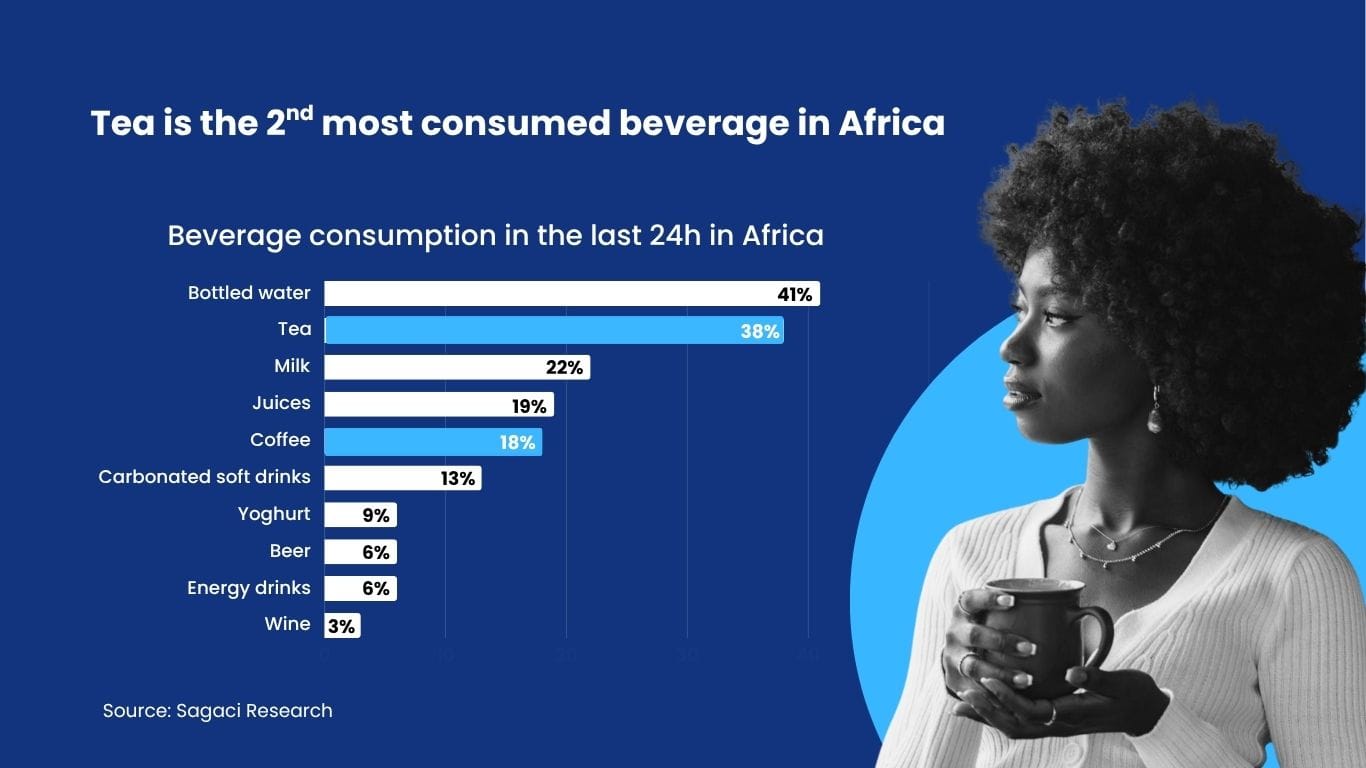
To the outside observer, Africa is synonymous with coffee. It is the birthplace of Coffea arabica, home to the legendary coffee ceremonies of Ethiopia, and the producer of some of the world’s most prized speciality beans from the volcanic hills of Rwanda and Kenya. Yet, a stark beverage divide runs through the continent’s consumer markets. Despite a highly publicised explosion of urban coffee shops and a rising middle class, tea remains the undisputed king of the everyday African household.
For fast-moving consumer goods (FMCG) brands, agribusiness stakeholders, and international investors, this is not a mere quirk of culinary taste. What goes into an individual’s morning mug is a highly sensitive barometer for broader African consumer behaviour. It reveals structural economic realities, the deep influence of informal retail networks, shifting demographic identities, and the delicate balance between tradition and modern aspiration. Understanding why tea holds such a stubborn, defensive advantage across Africa is essential for any business attempting to capture a slice of its massive food and beverage industry.
The History of Tea and Coffee in Africa
To understand modern beverage preferences in Africa, one must first untangle an agricultural paradox: how did a continent that grows some of the world’s finest coffee become an unyielding stronghold for tea consumption? The answer lies in the structural legacies of colonial economics and nineteenth-century trade patterns.
While coffee is indigenous to East Africa, specifically Ethiopia, where it has been consumed for over a millennium, the structured commercial cultivation of hot beverages across the rest of the continent was heavily shaped by European colonial administrations. In countries like Kenya, Malawi, Zimbabwe, and Uganda, colonial planners quickly realised that the fertile, high-altitude terrain was perfect for cash crops. However, the economic destiny of these two plants diverged sharply:
The Export-Oriented Coffee Economy: Coffee was treated from the outset as a high-value, luxury export meant to generate hard foreign currency for colonial empires and, later, post-independence governments. Domestic consumption was actively discouraged; local populations were rarely taught to roast, grind, or appreciate the bean. Coffee became something grown for others, detached from local culinary identity.
The Domestic Tea Engine: Conversely, tea plantations, pioneered heavily by British interests in Kenya and Malawi, were developed alongside a deliberate effort to foster domestic markets. Cheap, broken-leaf tea grades were retained locally. British colonial habits blended smoothly with local customs, creating a cheap, highly accessible domestic supply of black tea.
Why Tea Remains the Everyday Beverage for Many Africans
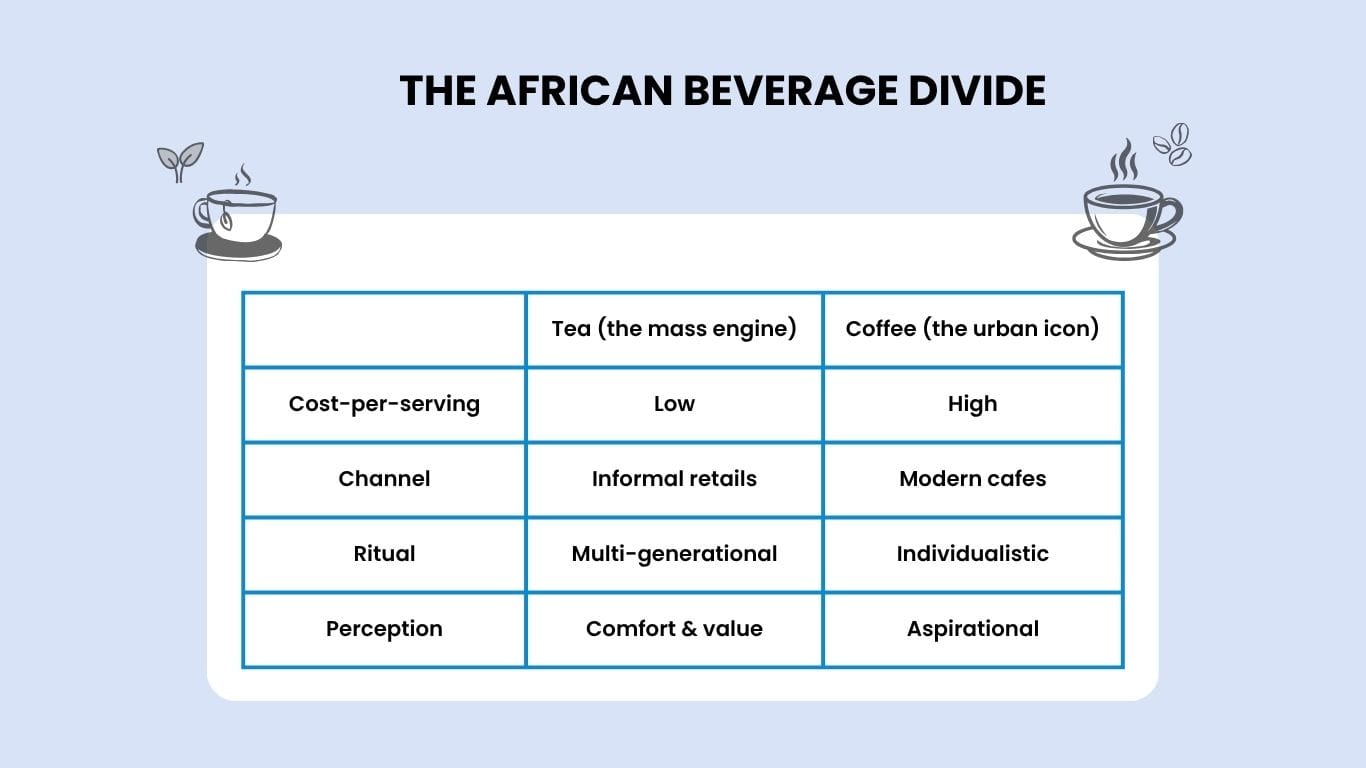
When evaluating the hot beverages consumed in Africa at scale, tea maintains an incredibly resilient defensive position. This dominance is sustained by four intersecting pillars: affordability, accessibility, household economics, and cultural simplicity.
Affordability
In a region where disposable incomes are frequently squeezed by inflation and economic volatility, value for money dictates purchasing behaviour. Tea wins the affordability battle by a landslide.
A single box of 50 or 100 tea bags is highly economical. A single tea bag or a small spoonful of loose leaves can be steeped multiple times or brewed in a large pot with a high volume of milk and water to serve an entire extended family.
Coffee, by contrast, is notoriously difficult to stretch. Instant coffee dissolves completely and requires a high volume of dry product per cup to taste acceptable, while ground coffee requires specialised equipment.
Accessibility
Over 70% of retail transactions across Sub-Saharan Africa occur within traditional, informal retail channels, open markets, roadside kiosks, and tiny independent grocers.
Tea brands in Africa, such as Unilever’s legacy Brooke Bond/Lipton brands or local giants like Kericho Gold (Kenya) and Glenryck, mastered this distributed landscape decades ago. They offer tea in ultra-affordable, single-serve sachets or micro-packs priced at accessible local coin denominations. Ground coffee requires airtight packaging, protective tins, or complex distribution setups that simply do not align with the dusty, high-turnover environment of traditional informal retail.
Household Economics
African consumer culture remains deeply collectivist and centred around the household unit. Breakfast is rarely an individualistic, grab-and-go affair; it is a shared family event.
Tea is uniquely suited to multi-generational households. It is mild enough to be given to young children (heavily diluted with sweetened milk) and traditional enough to satisfy the older generation. Coffee, with its bitter profile, high caffeine hit, and strong physical kick, is rarely viewed as an appropriate drink for children or a shared beverage for a mixed-age family breakfast table.
Cultural Simplicity
The physical preparation of tea requires no specialised knowledge or lifestyle adjustments. It requires only boiling water and a pot or a kettle. This ease of entry creates a powerful psychological comfort zone. For the vast majority of consumers, a hot cup of sweet, milky tea is tied intimately to notions of home, maternal care, and morning grounding. Breaking that lifetime loop of sensory familiarity is an immense hurdle for competing beverage segments.
The Rise of Coffee Culture in Urban Africa
Despite tea’s formidable mass-market defensive position, a counter-trend is sweeping across the continent’s major cosmopolitan nodes. Driven by rapid urbanisation, an expanding middle class, and changing demographic profiles, a sophisticated urban coffee culture in Africa is asserting itself aggressively.
In cities like Lagos, Nairobi, Johannesburg, Cairo, and Kigali, coffee is shifting away from being viewed as a bitter agricultural export commodity and is instead becoming a prized lifestyle experience.
This urban coffee transformation is powered by several distinct drivers:
The Third Space and Remote Work Culture: As digital services, technology startups, and gig economies expand across Africa, young professionals require a “third space” outside of the home and the formal office. Modern, aesthetically striking cafés equipped with reliable Wi-Fi have become the default meeting rooms, creative incubators, and social hubs for urban millennials and Gen Z.
Premiumisation and Aspirational Branding: Drinking a vanilla latte or an Ethiopian single-origin pour-over is highly performative. It acts as a badge of lifestyle success, sophisticated taste, and global connectedness. It is highly shareable on visual social media platforms like Instagram and TikTok, driving a virtuous cycle of aspirational consumption.
The Return of the Diaspora: Over the past decade, a steady influx of African diaspora professionals returning from Europe and North America has brought back deep-seated coffee-drinking habits. They have directly funded or patronised boutique, artisanal roasteries in their home countries, elevating local production standards.
Consumer Psychology: What Tea and Coffee Symbolise
To build an effective marketing strategy in this market, beverage manufacturers must understand that consumers are choosing a psychological identity, not just a flavour profile. The choice between tea and coffee is heavily loaded with emotional and symbolic meaning.
The Semiotics of Tea
Tea represents containment, stability, and restoration. It is the beverage of community and decompression. In many African cultures, offering a guest a cup of tea is an indispensable social lubricant and an expression of basic hospitality. It signals that you are welcome to sit, talk, and stay. It is unpretentious, dependable, and deeply safe.
The Semiotics of Coffee
Coffee, on the other hand, is the beverage of acceleration, ambition, and modernity. It symbolises the fast-paced, high-productivity demands of modern corporate and entrepreneurial life. Consumers drink coffee to “wake up,” tackle a heavy workload, or signal their identity as focused, upwardly mobile urbanites. It is individualistic rather than communal, often consumed in a personal travel mug on a commute or solo at a laptop.
Health and Wellness Trends Shaping Consumption
The global wellness movement has embedded itself firmly within Africa’s urban landscapes, fundamentally shifting how consumers interact with hot beverages. This health-conscious pivot presents unique tailwinds for both sectors.
The Functional Tea Boom
Tea is experiencing a massive renaissance as a functional health beverage. Beyond standard black tea, there is surging consumer demand for:
Herbal and Botanical Infusions: Ginger, hibiscus (bissap or zobo), moringa, lemongrass, and South African rooibos are growing rapidly due to their high antioxidant profiles and lack of caffeine.
Weight Management and Digestive Health: Slimming teas, detox blends, and green teas are highly popular among middle-class urban consumers focused on fitness and weight management.
The Clean Energy Coffee Narrative
Simultaneously, coffee is shedding its historic reputation as an unhealthy stimulant. Premium brands are successfully repositioning coffee as a natural, clean, sugar-free pre-workout energy source and a cognitive enhancer for performance-driven urbanites. The primary barrier remains sugar: traditional mass-market coffee consumption in Africa has historically relied heavily on dumping large amounts of condensed milk or refined sugar to mask bitterness. The modern wellness trend is slowly nudging premium consumers toward black coffee, pour-overs, and alternative dairy components like oat and soy milk.
Tea and Coffee Consumers
The dynamics of tea and coffee consumption across Africa are shaped by a fascinating interplay of historical trade economics, local agricultural production patterns, consumer demographics, and rapid urbanisation. While the continent is globally famous for its premium agricultural outputs, how these beverages are consumed domestically varies dramatically.
Gender influence
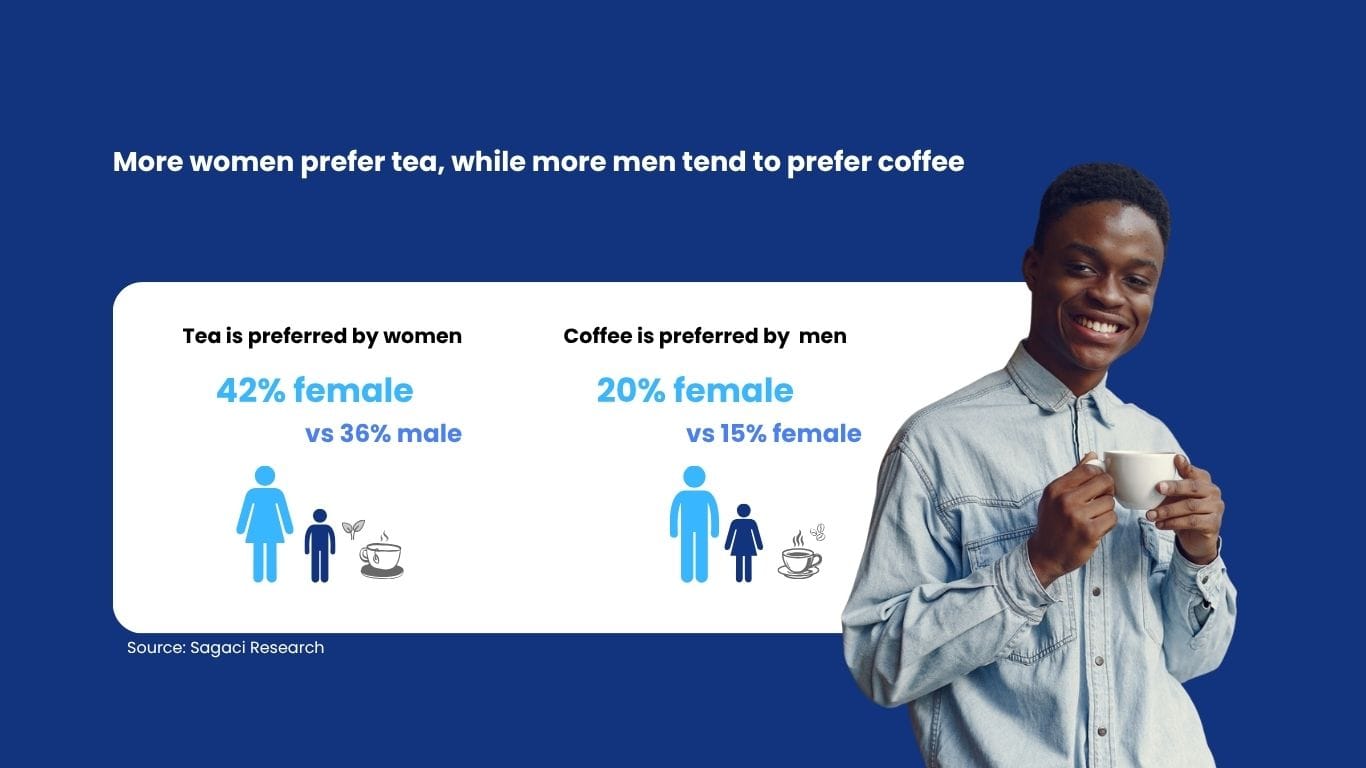
Male coffee trends. 20% of men had coffee in the last 24 hours, compared to 15% of women. For tea, the reverse is the case, with 42% of women and 36% of men drinking it. The two categories are targeting different consumers, and the gender split should influence both positioning and communication.
The “Cost-per-Serving” Metric
In terms of mass-market penetration across Africa, tea holds a massive defensive moat over coffee due to household economics. Data from the Food and Agriculture Organisation (FAO) highlights that global per capita tea consumption in developing and emerging markets, including Africa, grew by 2.5% over the past decade.
Furthermore, tea fits flawlessly into Africa’s dominant informal retail landscape (roadside kiosks, dukas, and spaza shops) where products are broken down and sold in ultra-affordable, single-serve micro-sachets matching daily wage cycles.
The Rise of Urban Coffee Culture
While tea dominates the domestic household kitchen, the fast-expanding African urban middle class is aggressively driving a premium coffee boom.
This directly matches broader global consumer behaviour studies, which show that roasted coffee beans and speciality coffee beverages are overwhelmingly favoured by younger cohorts (aged 18 to 30) living in cities with over 100,000 inhabitants, while traditional formats like instant coffee lean toward older, more conservative demographics.
What This Means for Beverage Brands
For FMCG companies, retailers, and entrepreneurs, navigating this beverage landscape requires a granular approach that balances volume plays against margin-driven premium plays.
Strategic Recommendations:
For Mass-Market Volume: Lean heavily into tea or instant coffee formats distributed via low-cost, single-serve sachets. Ensure your supply chain can seamlessly penetrate informal open-air markets and corner kiosks. Do not attempt to sell premium ground coffee beans or large formats in channels where household cash flow is highly restricted.
The Power of Localisation: Brands must respect local palate nuances. In East Africa, this means offering tea blends that hold up well when boiled directly with fresh milk and spices. In West Africa, it involves formulating instant beverage powders that dissolve rapidly in lukewarm water and come pre-blended with milk powder and sugar to maximise convenience.
The Hybrid “Teacoffee” and Flavour Innovation: There is an exciting, untapped middle ground for hybrid innovations. Products that offer the smooth, comforting ritual of tea but deliver the clean, high-caffeine functional kick of coffee can appeal strongly to urban workers looking for performance without the premium price tag.
Conclusion
For the global business leader, the beverage divide across Africa is a powerful reminder that consumer behaviour cannot be modelled using top-down assumptions. Just because a continent is an agricultural giant for a specific crop does not mean its people will automatically consume it. Choices in the market are deeply governed by historical trade tracks, the architecture of local retail systems, daily household dynamics, and the precise emotional needs of the consumer.
Whether engineering a mass-market product rollout or building an upscale urban café franchise, success hinges on respecting these deep cultural currents while building agile systems designed for tomorrow’s young, hyper-connected consumers.
Ready to Navigate Africa’s Consumer Landscape?
Building a winning brand in Africa’s dynamic food and beverage sector requires more than general data; it demands deep, culturally grounded market intelligence.
Contact Marketing Analytics Africa today to unlock granular market research, retail audit data, and tailored strategy frameworks designed to scale your business across African markets.