

From loadshedding-driven ultra-high-temperature (UHT) loyalty to private-label defection, the forces rewriting consumer behaviour in South Africa’s dairy market are more complex than any single brand strategy can encompass.
In an average South African household, milk is not considered a purchase. You need it. You buy it. It sits in the fridge.
Except that it does not sit in the fridge anymore. It sits on the shelf, in a UHT carton that does not require refrigeration, lasts for months, and costs less in an economy where every rand is rationed. And often, it does not carry the name Clover or Parmalat on the label. It carries the name Pick n Pay, Shoprite or Woolworths.
South Africa’s milk market is undergoing a structural shift in consumer behaviour that is forcing every player in the dairy sector, from heritage brands to fresh processors, to rethink how they compete for loyalty in a market shaped by inflation, load shedding, health consciousness, and the relentless rise of private label.
The Market: Who Is Competing for the Milk Aisle
South Africa’s dairy processing sector is concentrated and consolidating. The USDA’s Foreign Agricultural Service Pretoria report (February 2025) notes that 10 processors now account for approximately 70% of the dairy processing sector. The leading brands are Clover (part of the Israeli Milco group since 2021), Lactalis South Africa (which owns the Parmalat brand), Woodlands Dairy, Danone, Dewfresh, and Nestlé SA.
Clover remains the most recognised dairy brand in South Africa, based on consumer scanning data, according to Sagaci Research’s 2026 market intelligence. Lactalis, through Parmalat, retains overall category leadership in dairy products and alternatives according to Euromonitor, supported by its broad portfolio spanning long-life milk, flavoured milk, buttermilk, and cream.
But market share in this category is increasingly contested not just among these incumbents, but also between them and the growing power of retailers’ own brands. And that shift is being driven almost entirely by consumer behaviour, not by brand strategy.
Force One: Price Sensitivity and the Private Label Surge
South Africa’s food inflation reached a 14-year high of 14.4% in 2023, according to Stats South Africa, before beginning a gradual decline through 2024. Even as inflation eased, the behavioural scars remained: consumers who shifted to private label during the peak pressure years largely did not shift back.
Euromonitor’s 2024 report on South Africa’s drinking milk products market is unambiguous on this point: private label is set to maintain its strong position, with retailers’ investments in price promotions and generally lower costs working in their favour as increasingly price-sensitive consumers switch without hesitation.
This is the defining competitive challenge for branded milk producers. The category is nutritionally standardised, full cream milk from Clover and full cream milk from Pick n Pay’s own brand deliver effectively the same product in the same regulatory environment. In that context, the premium that a brand commands must be earned through something beyond the product itself: heritage, advertising, packaging trust, or retail experience.
The brands that have most effectively maintained their premium are those with strong television and radio campaign histories. Clover’s longstanding TVC presence, which, by the way, was built around family, freshness, and South African life, has created a brand equity reservoir that private labels cannot easily match. Parmalat’s advertising across radio and print in regional markets has similarly reinforced perceptions of quality. But the erosion is ongoing and accelerating among younger, urban, price-aware consumers.
Force Two: Load Shedding and the Cold Chain Problem
No environmental factor has reshaped South African dairy consumer behaviour more profoundly in recent years than load shedding. At its peak, South Africa experienced more than 280 days of scheduled power outages in 2024, according to Eskom operational data.
For fresh milk, which requires continuous refrigeration across the entire supply chain, this was devastating to consumer confidence and purchasing behaviour. A power outage that warms a fridge for four to six hours can spoil fresh milk in a way that is invisible until after purchase. Consumers learned this lesson, and they responded rationally.
According to Fact.MR’s market analysis, UHT milk sales in South Africa were projected to reach 282.8 million in 2024. The market in the country is expected to grow at a 6.5% CAGR and reach US$530.8 million by the end of 2034. The driving force, as explicitly noted in the report, is poor cold-chain infrastructure and unreliable cold storage, which are pushing demand for UHT products that can be stored without refrigeration.
The practical consequence for brands: Clover’s UHT range and Parmalat’s long-life products have benefited from load shedding in ways their fresh milk lines have not. Euromonitor notes that between July 2023 and July 2024, retail sales of UHT milk increased more than those of other dairy categories, suggesting shifts in consumption across both lower- and higher-income groups.
Brands that invested in communicating the reliability and shelf stability of their UHT products during this period captured lasting volume gains that persisted even as load shedding eased in the first half of 2024.
Read also: Demographic Shifts Impacting African Consumer Trends
Force Three: Health, Wellness, and the Alternative Milk Question
The South African Q4 2024 dairy market report notes a strong and growing consumer preference for health-oriented dairy products, including probiotic-enriched options, low-fat variants, and lactose-free milk. This trend is driven by expanding nutritional awareness, rising rates of lactose intolerance diagnoses, and an urban middle class increasingly influenced by global wellness media.
Plant-based milk alternatives (soy, oat, almond, and rice milk) are growing, though from a small base. According to Persistence Market Research and other industry analysts, the trend is most pronounced among urban, high-income, health-conscious consumers and poses a legitimate long-term structural threat to traditional dairy volumes, though it has not yet reached the scale seen in Western European markets.
For mainstream brands, the response has been product extension. Clover and Parmalat both maintain lactose-free ranges and reduced-fat offerings. Woolworths and Pick n Pay have expanded their own-label health-oriented dairy sections, creating further private label competition in the very sub-categories where branded producers hoped to hold a premium.
Force Four: Packaging, In-Store Presence, and Traditional Advertising
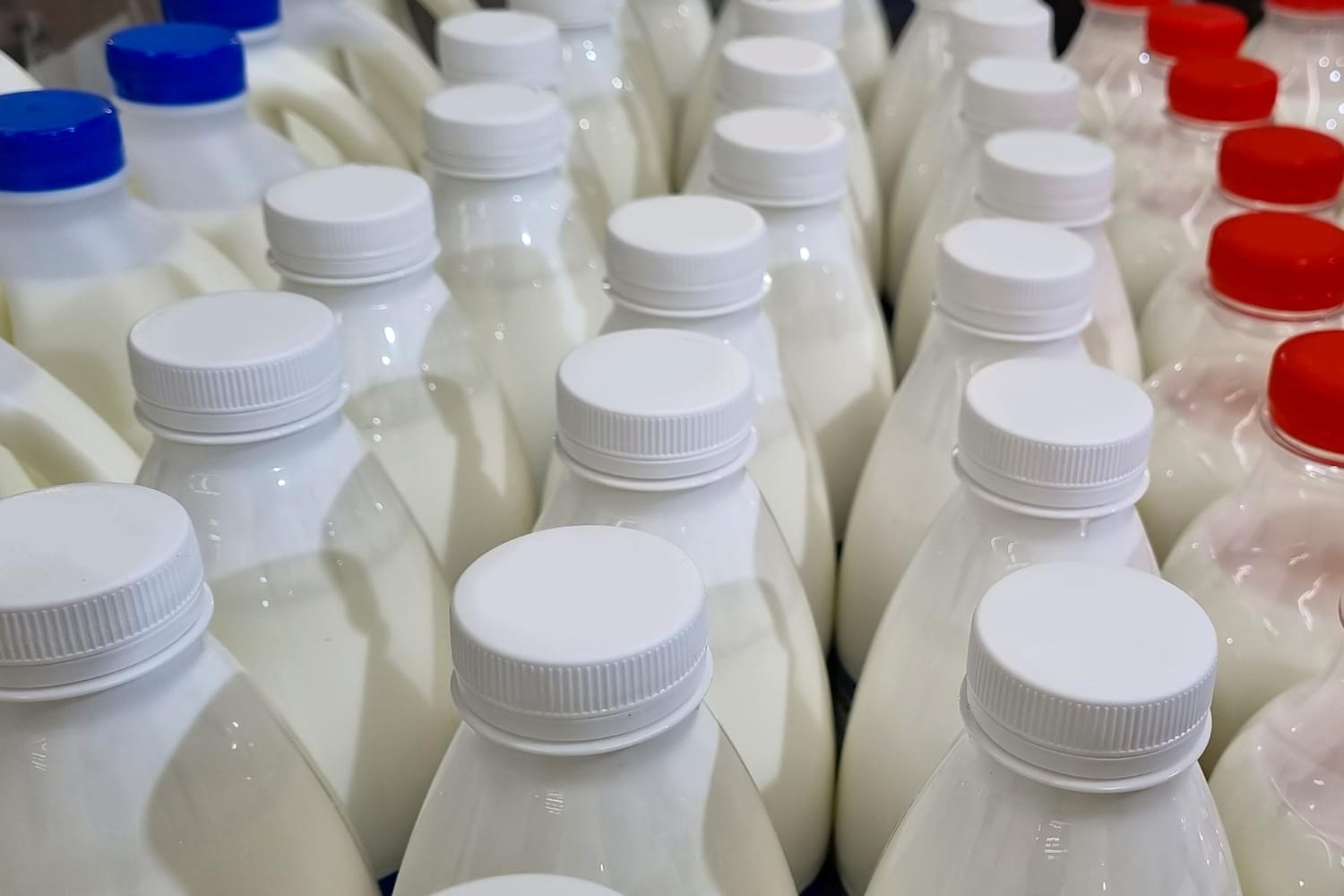
The milk aisle is won and lost at the point of sale in a way that few other FMCG categories match. Consumers in South Africa increasingly shift from weekly to monthly shopping trips to large supermarkets and hypermarkets. which means the in-store impression must work harder and faster.
Packaging carries enormous weight in this environment. Clover’s distinctive blue, red and white branding, maintained consistently across decades of advertising, gives it immediate shelf recognition. Parmalat’s royal blue packaging signals the Lactalis Group’s international heritage of quality. Both brands invest in prominent shelf placement, chilled-display dominance, and promotional pricing during key consumer moments such as the school start season, Easter, and year-end.
Television and radio remain highly relevant channels in South Africa’s milk market, contrary to the assumption that FMCG advertising has fully migrated to digital. Community radio, in particular, with its deep penetration into township and semi-rural markets, is a critical touchpoint for brands competing in lower-living-standard measure (LSM) segments. Brands that have maintained a consistent community radio presence have held volumes in markets where private label alternatives are less visible.
Outdoor advertising, billboards at taxi ranks, community notice boards, and branded cooler units at spaza shops and independent retailers form the traditional media backbone for dairy brands competing outside formal retail channels. With a significant proportion of South Africa’s dairy purchased through the informal sector, this physical brand presence cannot be substituted by digital media alone.
What the Data Says About Brand Loyalty in This Category
The honest conclusion from available market data is that South African milk brand loyalty is real but brittle. It exists most strongly among older consumers, in higher-income LSM groups, and in households that experienced specific positive brand moments, a quality guarantee honoured, a promotion that felt generous, a TVC that resonated emotionally, etc.
Among younger consumers, price sensitivity and private-label familiarity are eroding loyalty in ways that traditional advertising alone cannot reverse. The brands holding their ground most effectively are those that combine a consistent advertising presence with in-store dominance, community-level engagement, product innovation in growth sub-categories (UHT, lactose-free, reduced-fat), and a price architecture that makes a premium feel justifiable.
The structural challenge is clear: the South African dairy market is a battleground where heritage brands must simultaneously fight each other, private labels, alternative milks, and the macroeconomic forces that make consumers increasingly unwilling to pay a brand premium for a product whose core utility is identical regardless of the label.
The brands that will lead this market 5-10 years from now will not be the ones that spend the most on advertising. They will be the ones who understand what their specific consumers value, why, and exactly when they are most open to switching. That understanding begins with data, and it ends with a decision that was never a pour decision at all.
At Marketing Analytics Africa (MAA), we help businesses navigate the shifts in African markets with data-backed insights and innovative marketing solutions.
Are you looking to future-proof your brand for Africa’s next-generation consumers? Contact MAA today to craft a winning marketing strategy.