

At first glance, the headline figures for startup funding in Africa in the first half (H1) of 2026 suggest a story of remarkable, almost defiant resilience. After a bruising couple of years defined by a brutal global “venture winter,” the African tech ecosystem appeared to have finally found its footing.
Between January and June 2026, tech startups across the continent collectively pulled in between $1.3 billion and $1.44 billion. This is remarkably consistent with the $1.4 billion raised during the same period in 2025.
However, looking strictly at the headline total is like looking at the weather forecast without stepping outside. A deeper dive into the transaction data reveals a complex, “hall of mirrors” effect. While the capital inflow remained stable, almost every underlying structural metric shifted dramatically. The era of “growth at all costs” has been thoroughly dismantled. In its place is a highly concentrated, asset-heavy, and risk-averse investment environment.
This comprehensive analysis breaks down the reality of Africa’s startup funding in H1 2026, examining the seismic shift in investor behaviour, and highlighting what founders must do to survive and thrive in this new economic landscape.
What Happened in H1 2026?
For most of H1 2026, it looked as though technology investment in Africa was headed for a historic slump. By the end of May, the continent’s startups had collectively raised just $843 million, representing a steep 21% year-on-year drop.
Then came June.
June 2026 alone delivered a staggering $515 million injection, single-handedly turning the year’s trajectory around. This massive surge was driven by a handful of blockbuster late-stage transactions, most notably a colossal $215 million funding package secured by the pan-African electric mobility firm Spiro.
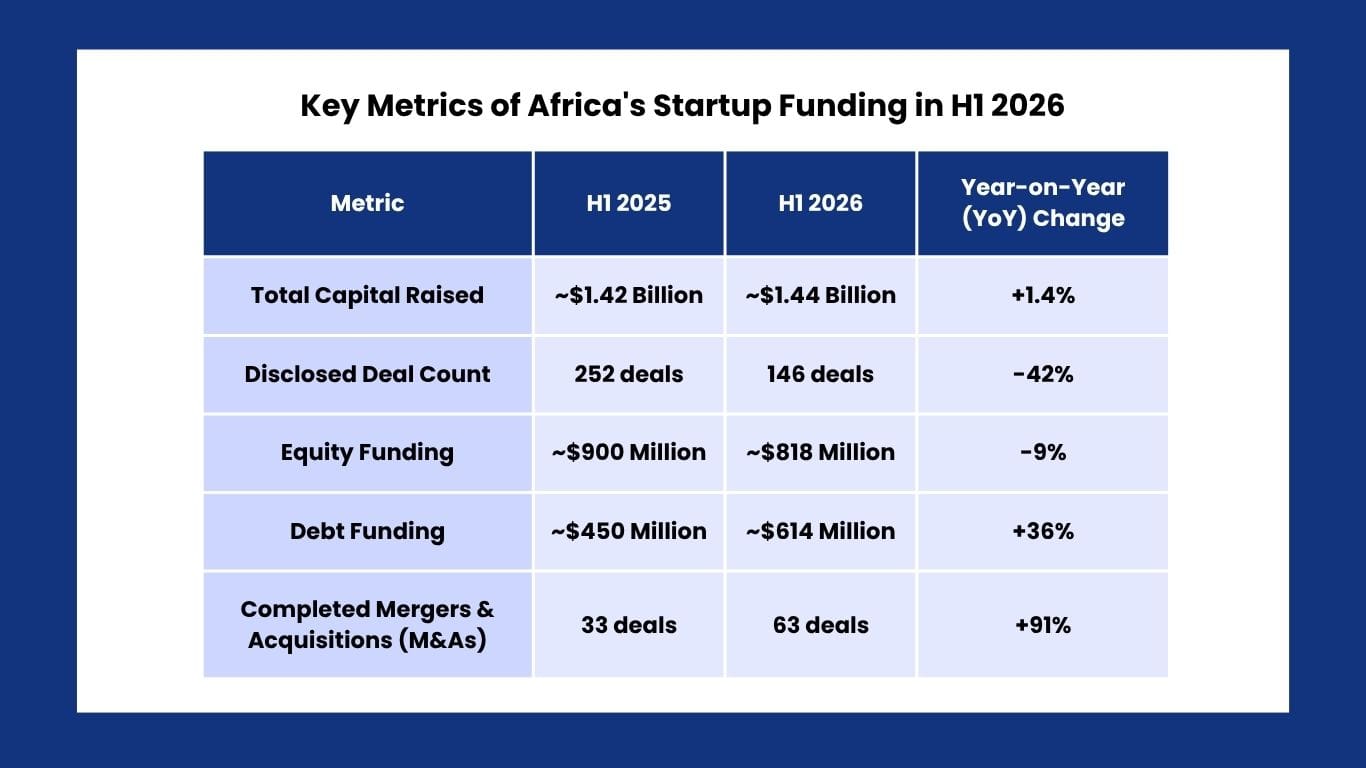
While the total capital volume remained strong, transaction velocity plummeted. Only 146 to 190 startups secured funding in H1 2026 (depending on tracking thresholds), down sharply from the 252 deals recorded in H1 2025.
The table below outlines the high-level metrics of the ecosystem’s performance:
Key Metrics of Africa’s Startup Funding in H1 2026
Investor Behaviour: The Biggest Story
The most critical trend of H1 2026 is the widening disconnect between capital volume and deal velocity. We are witnessing a clear barbell effect in the market:
1. The Missing Middle and the Seed-Stage Slump
The number of startups raising between $100,000 and $1 million fell by a staggering 44% compared to the previous six months. This represents a severe underinvestment in early-stage innovation. If this trend persists, it will create a critical pipeline issue, leaving fewer mature startups capable of raising Series A or B rounds in 2028 and beyond.
2. A Flight to Quality and Asset-Heavy Infrastructure
Instead of backing dozens of unproven software concepts, venture capital in Africa is backing larger, asset-heavy companies with clear physical infrastructure, proven unit economics, and defensive moats. Investors want hard assets that can back debt or act as collateral.
3. Debt is No Longer a Last Resort
Historically, startups turned to debt when they couldn’t raise equity. In H1 2026, debt emerged as a primary instrument of choice, accounting for $614 million, or nearly 43%, of all capital raised. Debt allows mature companies to fund capital-intensive operations (like buying electric motorcycle fleets or solar panels) without diluting early founders and investors at low valuations.
4. A Record-Breaking Wave of Mergers and Acquisitions (M&As)
Unable to secure fresh equity, many early-and mid-stage startups chose consolidation over closure. H1 2026 recorded an unprecedented 63 M&A deals, nearly double the 33 tracked in H1 2025:
Flutterwave acquired banking platform Mono in an all-stock transaction valued between $25 million and $40 million.
Paystack took over digital banking startup Brass.
Global acquisitions also made waves, such as US-based nCino acquiring South African fintech DocFox for $75 million, and MNDR purchasing insurtech pioneer Bima for $119 million.

Which Countries Led the Way?
Geographically, the “Big Four” continued to dominate startup investment on the continent, though the internal rankings shifted.
Egypt took the crown for total capital in Q1, pulling in $190 million. The Egyptian market has proven highly adept at structuring massive debt deals, such as ValU’s $63.6 million debt facility from the National Bank of Egypt.
South Africa followed closely with $157 million. Its sophisticated financial sector unlocked significant local currency project debt, highlighted by SolarAfrica’s $94 million round.
Nigeria led the continent in terms of absolute deal volume, proving that its early-stage entrepreneurial engine remains highly active. However, in terms of total capital, its $78 million fell significantly behind Egypt and South Africa due to a temporary lack of mega-growth rounds.
Kenya maintained a strong showing, particularly as a hub for climate tech and electric mobility, anchoring massive pan-African players.
Which Sectors Attracted the Most Capital?
The sector dynamics of H1 2026 reflect a pivot toward real-world utility, sustainability, and physical infrastructure.
Climate Tech & Electric Mobility: This was the breakout sector of the half-year. June was dominated by Spiro’s $270 million mega-deal, while South Africa’s Zimi Charge raised $2.6 million to scale EV charging networks.
Fintech: While it no longer commands 60%+ of all capital as it did in 2021, fintech funding in Africa remains highly resilient. It led Q1 deal volume with 20 out of 59 transactions, pulling in $208 million. The focus has shifted from simple consumer wallets to credit infrastructure, B2B lending, and payment rails.
Agritech & Energy: Climate-smart agriculture and decentralised power attracted massive checks, led by biodigester manufacturer Sistema.bio’s $53 million growth round in Kenya, and SolarAfrica’s $94 million clean energy project debt.
AI & Deep Tech: Though still in its infancy on the continent, AI began attracting institutional capital. Customer automation startup AethexAI raised $3 million in a pre-seed round led by 4DX Ventures and Enza Capital.
What This Means for African Founders
For founders navigating this market, the operational reality has fundamentally changed. The playbooks of 2021 are not just obsolete; they are dangerous.
Focus on Capital Efficiency, Not Valuation
With equity scarce, founders must treat every dollar as if it is their last. Focus on reaching cash-flow positivity early. Investors are no longer willing to fund unprofitable growth in the hopes of a future markup.
Build a Balanced Capital Stack
Don’t rely solely on equity. If your business involves physical inventory, hardware, or lending, explore debt options early. However, ensure your unit economics can comfortably cover the cost of interest, especially in high-inflation environments.
Be Open to M&A
If fundraising stalls, do not wait until your cash runway is measured in weeks to seek an exit. The surge in H1 2026 M&As shows that joining forces with a larger, well-capitalised competitor (like Mono joining Flutterwave) is a highly viable path to preserve value and scale.
What Investors Are Looking For in 2026
Across nearly every tracker, the same investor priorities recur: stronger unit economics, clear paths to profitability, asset-backed collateral where relevant, and experienced founding teams. The data bears this out: average deal sizes have risen even as deal counts have fallen, and growth-stage companies commanded a disproportionate share of the total pool in the first quarter, according to Launch Base Africa’s analysis of TechCabal data.
Development finance institutions continued to play an outsized role, particularly in climate and infrastructure financing; the International Finance Corporation was cited as appearing in more African deals in early 2026 than any other single investor. That pattern reflects a broader trend: as pure venture capital becomes more selective, DFIs, development banks and blended-finance vehicles are stepping in to underwrite the infrastructure bets that commercial investors increasingly favour but are not always positioned to fund alone.

Outlook for H2 2026
Whether the second half of 2026 extends the June rebound or reverts to the slower pace of the first five months remains genuinely uncertain, and trackers are cautious about extrapolating from a single strong month. What can be said with more confidence, based on the H1 data, is that debt and hybrid financing structures are likely to remain prominent for asset-heavy sectors such as mobility and energy, and that M&A activity, already at a record half-year pace, could continue as tighter equity conditions push weaker startups toward consolidation rather than shutdown.
Early-stage funding is the area most exposed to risk. With deals in the $100,000–$1 million range down 44% and seed-stage activity at multi-year lows across several trackers, a thinner pipeline of Series A-ready companies could become apparent within eighteen to twenty-four months if the trend persists. Whether policymakers, development finance institutions or angel networks step in to address that gap is one of the more consequential open questions for H2.
Key Takeaways
- H1 2026 African startup funding totalled between $1.21 billion and $1.5 billion depending on the tracker, with Africa: The Big Deal ($1.36bn) and TechCabal Insights ($1.44bn) the two most widely cited, methodologically transparent figures.
- The $1.3 billion figure widely quoted in early June was an interim snapshot, not the final H1 total.
- Deal count fell by roughly 42%, even as total capital held broadly steady , a sign of extreme concentration at the top of the market.
- Debt and hybrid financing instruments now rival or exceed equity in several sectors, particularly mobility and energy.
- M&A activity nearly doubled year-on-year, with 63 transactions recorded in H1 2026.
- Nigeria, Kenya, Egypt and South Africa still dominate, but their combined share of deal count fell from 64% to 53%.
Conclusion
The question posed by this article’s headline, “Did Africa’s tech ecosystem truly raise $1.4 billion in H1 2026?”, has a more nuanced answer than a single number can offer. The figure that matters most for understanding where African venture capital trends are heading is not the total. It is the fact that this money reached fewer than half the number of companies it did a year earlier, that debt has become a mainstream financing tool rather than an exception, and that consolidation through M&A is now a defining feature of the market rather than a footnote.
For founders, investors and policymakers, the real question for the second half of 2026 is not whether the headline total will rise again. It is whether the ecosystem can widen its base of funded companies before the current concentration of capital narrows the pipeline of future growth-stage businesses too far to recover quickly.
At Marketing Analytics Africa, we empower African businesses to make smarter decisions through data-driven marketing strategies. Inspired by innovative companies like Flutterwave, it’s time for your brand to harness the power of analytics to scale, optimise, and lead in the digital economy.
Join our community of forward-thinking marketers.
Subscribe to our newsletter, attend our webinars, and explore our tools to turn insights into impact.
Let’s transform African marketing together.
Visit www.marketinganalytics.africa to get started.