

In the first half of 2026, Kenya occupied a uniquely compelling position in Africa’s economic story. As one of the continent’s most digitally advanced, demographically young, and consumer-driven economies, Kenya is a laboratory for brand building unlike any other. From mobile-money-powered fintechs to heritage beverages carrying AAA+ brand ratings, Kenya’s brand ecosystem is both a mirror of national ambition and a template for the wider African market.
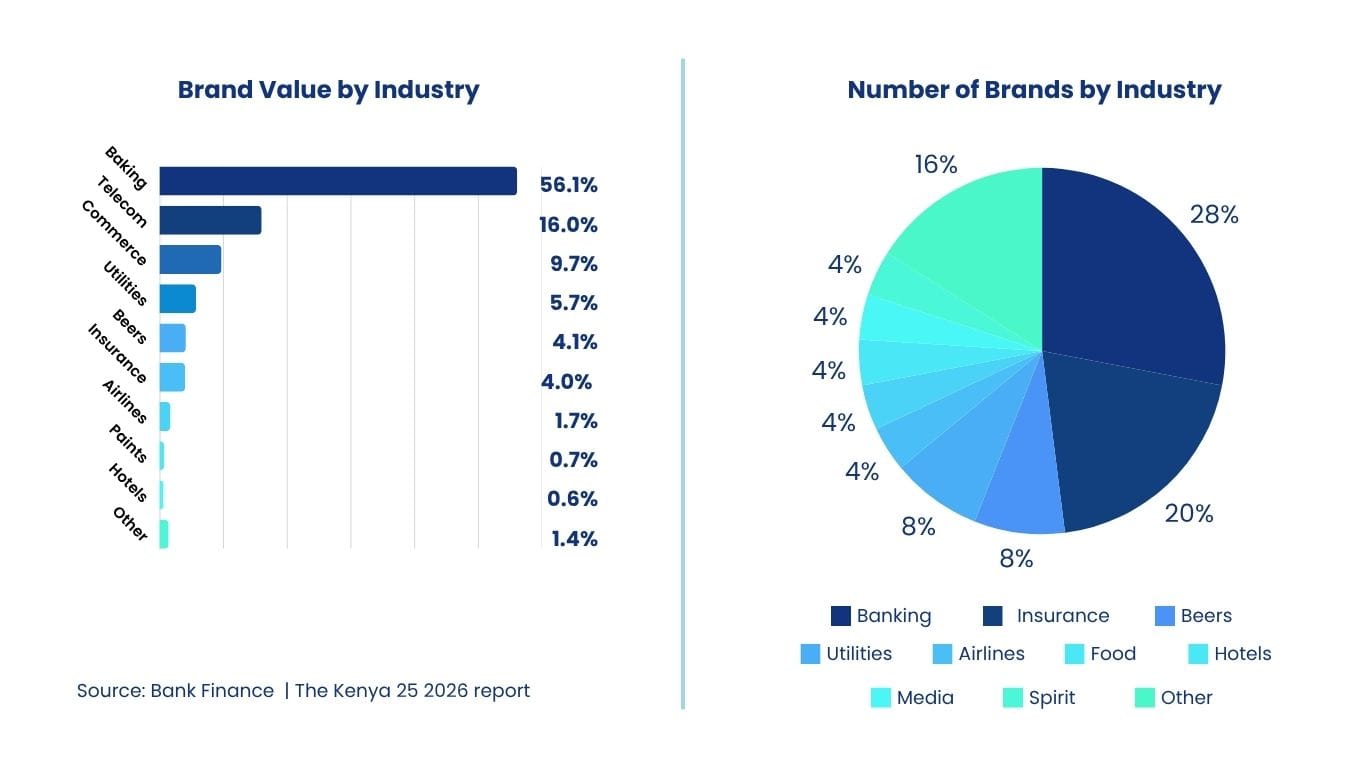
The Kenya 25 2026 report by Bank Finance confirms what many African brand strategists have long suspected: Kenyan brands are growing in value, in resilience, and in strategic sophistication. The collective value of the country’s top 25 brands rose 3% to KES 349 billion, driven by a banking sector that contributes more than half of that total. Yet beneath the headline numbers lies a richer story about consumer behaviour, generational brand loyalty, digital transformation, and the persistent tension between local identity and global aspiration.
This article synthesises the latest available brand intelligence, consumer insights, and market data to deliver a comprehensive benchmark of Kenya’s brand landscape. It is designed for CMOs, brand managers, marketing executives, investors, and business leaders who need more than data points; they need strategic clarity.
Kenya ranked 88th in the Global Soft Power Index 2026, improving from 91st in 2024; a signal of rising national brand equity on the world stage.
Kenya’s Most Valuable Brands in 2026 So Far
The Ranking Overview:
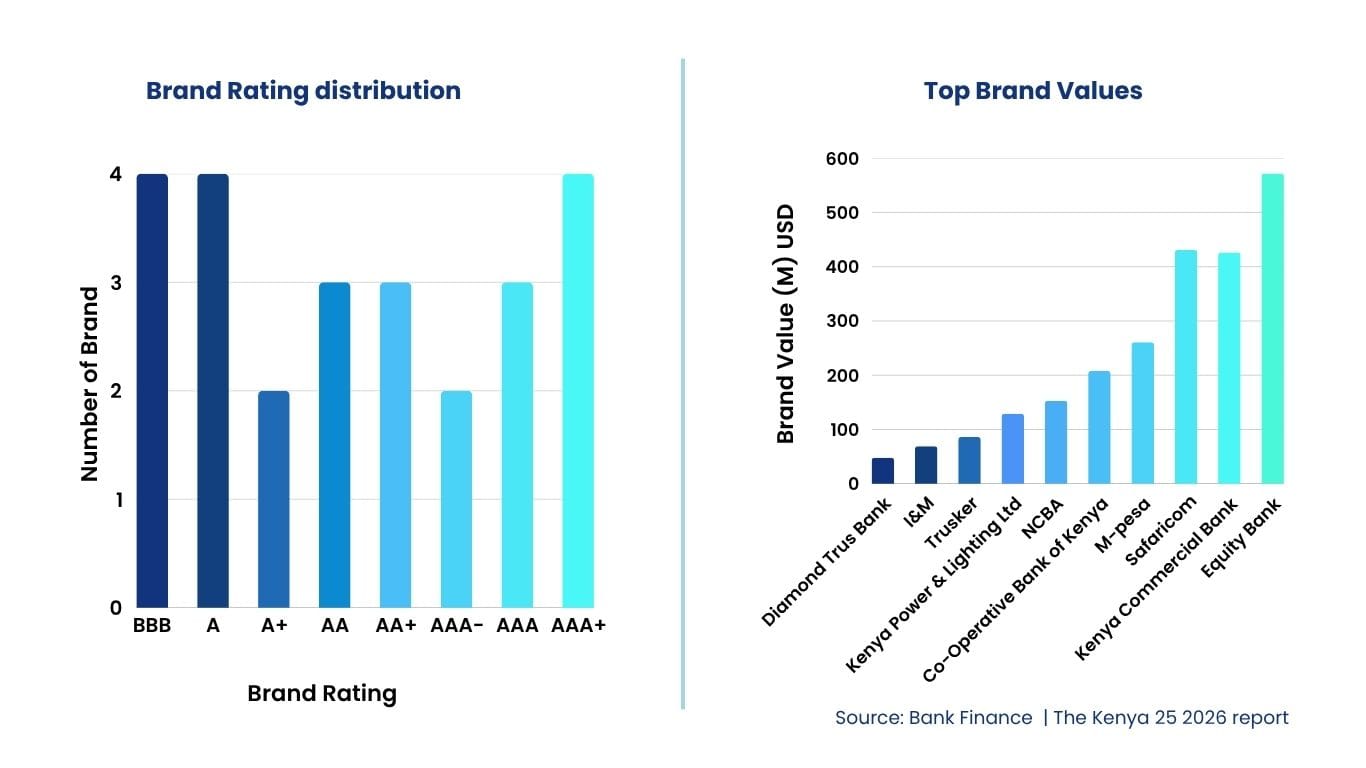
The Brand Finance Kenya 25 2026 report documents a market defined by financial sector dominance and selective high-growth challengers. The top 25 brands collectively reached KES 349 billion in combined brand value, with the banking sector alone contributing KES 196 billion (or 56% of the total). Six of the top ten brands are banks, a concentration that reflects both the sector’s economic importance and its sophisticated investment in brand equity.
Top 10 Performing Brands aT a Glance
| Rank 2025 | Rank 2026 | Brand | Category | Brand Value | Rating |
|---|---|---|---|---|---|
| 1 | 1 | Equity Bank | Banking | $572M | AAA+ |
| 3 | 2 | Kenya Commercial Bank | Banking | $462M | AAA+ |
| 2 | 3 | Safaricom | Telecoms | $431M | AAA |
| 4 | 4 | M-PESA | Telecom | $261M | AAA |
| 5 | 5 | Co-operative Bank of Kenya | Banking | $208M | AA+ |
| 6 | 6 | NCBA | Banking | $153M | A+ |
| 7 | 7 | Kenya Power & Lighting Ltd | Energy | $129M | AAA |
| 8 | 8 | Tusker | Beverages | $86M | AAA+ |
| 9 | 9 | I&M | Banking | $69M | AA |
| 12 | 10 | Diamond Trust Bank | Bank | $48M | BBB |
What these rankings signal is not just financial performance. Each of these brands has mastered a particular form of trust: Equity Bank through financial inclusion, Safaricom through infrastructure dependency, Tusker through cultural resonance, and CIC through community-oriented insurance products tailored to underserved Kenyan demographics.
Why Kenyan Banks Dominate Brand Rankings
The Financial Inclusion Imperative
Banking brands dominate Kenya’s brand landscape because they have done something most banks elsewhere in the world have failed to achieve: they have made themselves indispensable to everyday life. Equity Bank, which retained its crown as Kenya‘s most valuable brand for the third consecutive year at USD 554 million, built its reputation not by targeting the affluent, but by aggressively serving the unbanked and underbanked majority.
KCB Group, NCBA, and Co-operative Bank follow a similar playbook, leveraging Kenya’s high mobile phone penetration, strong regulatory framework under the Central Bank of Kenya, and a consumer base that is increasingly financially literate. Six of Kenya’s top ten brands are banks because banking is not just a sector here; it is the connective tissue of the economy.
Digital Banking and the Mobile-First Revolution
The rise of mobile banking has been transformational. M-PESA, operated through Safaricom, has redefined what financial services can look like in Africa, with a Sustainability Perception Value of USD 93 million, the highest among Kenyan brands in this category. Banks that integrated with or competed intelligently against M-PESA (such as Equity Bank through Equitel and EazzyBanking) gained brand equity by demonstrating technological relevance.
NCBA’s Loop platform and Co-operative Bank’s MCo-op Cash application illustrate the sector-wide pivot toward app-first banking. These are not just product features; they are brand signals that communicate modernity, security, and convenience to a consumer base that has bypassed traditional banking infrastructure entirely in favour of mobile-first solutions.
The Trust Economy
Perhaps the most underappreciated reason for banking brand dominance in Kenya is trust. In a market where many sectors (retail, logistics, food delivery) are still building consumer confidence, Kenyan banks have accumulated decades of regulatory credibility. Brand trust, once earned, creates remarkable pricing power, customer retention, and advocacy effects that smaller categories struggle to replicate.
Banking contributes 56% of Kenya’s total top-25 brand value (KES 196 billion), reflecting an unmatched combination of financial inclusion, digital adoption, and consumer trust.
Read also: Building Trust with Data Privacy and Transparency in the African Market
Safaricom, M-PESA, and the Power of Telecom-Driven Brand Equity
Beyond Connectivity: A Platform Brand
Safaricom is Kenya’s most powerful non-banking brand, and arguably the single most transformative corporate entity in the country’s economic history. With a brand value of USD 453 million, it is not merely a telecommunications company; it is the infrastructure layer upon which much of Kenya’s digital economy runs.
M-PESA, Safaricom’s flagship mobile money product, processes billions of dollars in transactions annually and has become a national utility. Its brand recognition transcends demographics and geography. For rural Kenyans, M-PESA is banking. For urban millennials, it is the default payment rail for everything from rent to e-commerce. For regional markets across Africa, it is the aspirational model for mobile financial inclusion.
Sustainability Leadership as Brand Strategy
Safaricom’s Sustainability Perceptions Value of USD 93 million (2023 data) places it at the vanguard of purpose-driven brand strategy in East Africa. In a market increasingly aware of corporate social responsibility, from youth-led climate activism to ESG expectations from international investors, Safaricom’s leadership on environmental and social sustainability creates a brand moat that pricing-focused competitors cannot easily cross.
The Lipa Na M-PESA ecosystem, M-PESA Global, and M-PESA for Business demonstrate a deliberate brand extension strategy that keeps Safaricom relevant across the entire commercial lifecycle, from street hawkers to SMEs to large corporations.
Consumer Trends Reshaping Kenyan Brands in 2026
The Local vs. Global Brand Paradox
One of the most revealing data points in Kenya’s brand intelligence is this: despite strong national pride and patriotism, only 25% of the most admired brands in Kenya are local. This is not a contradiction; it is a strategic opportunity. International brands have invested heavily in aspirational positioning, global quality signals, and youth-targeted marketing that Kenyan brands have historically underinvested in.
Nike, Samsung, and Coca-Cola dominate generational brand preferences across Gen Z, Millennials, and Gen X, respectively. These brands win not just on product quality, but on cultural relevance; they appear in music, sport, social media feeds, and the self-identity narratives of Kenyan consumers. Kenyan brands that aspire to compete must invest in cultural storytelling, not just product communication.
Generational Brand Preferences: A Strategic Segmentation
Gen Z (1997-2012): Nike leads as the preferred brand, reflecting this generation’s orientation around sport, streetwear culture, and digital-native identity. TikTok, Instagram Reels, and YouTube Shorts serve as their brand discovery channels.
Millennials (1981-1996): Samsung dominates, a signal of technology-driven aspiration. Millennials are Kenya’s primary smartphone consumers, and device brand loyalty is deeply entwined with social status and productivity identity.
Gen X (1965-1980): Coca-Cola retains its authority, a testament to the enduring power of emotional brand equity built over decades and consistently activated through localised Kenyan storytelling.
For Kenyan brand managers, this segmentation demands differentiated communication strategies. A single brand voice cannot simultaneously speak authentically to all three generations.
Retail Experience: NPS as the New Brand Metric
Net Promoter Score (NPS) is emerging as the most consequential metric for Kenyan consumer brands in the experience economy. Carrefour holds the highest retail NPS in Kenya at 65, followed by Naivas, a homegrown supermarket chain that has rapidly expanded to become a genuinely beloved local brand. Carrefour’s success in Kenya is instructive: international brands that localise deeply in product range, pricing, and store experience can command world-class NPS scores in African markets.
In food delivery, Jumia Food leads with an NPS of 3, a figure that points to significant headroom for improvement across the sector. Delivery reliability, cold chain logistics, and customer communication remain unresolved brand equity drains for digital food platforms in Kenya.
The Rise of Experience-Led Branding in Kenya
Kenya’s most admired brands in 2026 share a common trait: they have shifted from transactional to relationship-based brand architectures. Equity Bank’s “Wings to Fly” scholarship programme is more than CSR; it is brand equity compounding in real time. Every beneficiary is a lifelong brand ambassador. Naivas’s rapid store expansion, combined with its product breadth and community pricing strategy, generates organic loyalty that no advertising spend can fully replicate.
For brand managers across Africa, the lesson is clear: the consumer experience IS the brand in 2026. The brochure, the TVC, and the influencer post can attract a customer. But only an exceptional experience will retain them.
Omnichannel Engagement as Brand Infrastructure
The most valuable Kenyan brands are also the most omnichannel. Equity Bank is accessible in branches, via the Equity Mobile app, through USSD, via agents in rural areas, and on WhatsApp. Safaricom integrates physical stores, M-PESA agents, the MySafaricom app, and a 24/7 customer care infrastructure. This ubiquity is not convenience; it is brand strategy. Every touchpoint is a brand moment, and the brands that win in Kenya are those that have engineered high-quality brand moments at every interaction layer.
Influencer Marketing and Kenya’s Creator Economy
The Numbers Behind Kenya’s Creator Boom
Kenya’s creator economy has gone from being an emerging phenomenon to becoming a measurable, commercially significant brand channel. In 2025, social media influencers earned a combined KES 296 million, with total creator payouts across the ecosystem exceeding KES 1 billion. For brand managers, these numbers reframe the influencer marketing conversation entirely.
Platform Dynamics: TikTok, Instagram, YouTube, and X
TikTok has emerged as the fastest-growing brand discovery platform for Kenyan Gen Z consumers, with Nairobi-based creators building pan-African audiences through lifestyle, humour, and commentary content. Instagram remains the aspirational commerce platform of choice for millennial consumers, particularly in fashion, beauty, and food categories. YouTube anchors long-form brand storytelling, from product reviews to business education content. X (formerly Twitter) continues to serve as Kenya’s real-time brand sentiment arena, where viral conversations can make or break a brand’s reputation within hours.
Creator-Led Commerce: The Next Frontier
The intersection of creator culture and e-commerce, often called social commerce, is accelerating in Kenya. Brands that have embedded themselves within creator communities, rather than simply sponsoring content, are seeing measurable brand equity gains. The shift from “influencer as megaphone” to “creator as co-brand” is the defining evolution in Kenyan marketing communication for 2026.
Brands that succeed in this environment share three traits: they give creators genuine creative latitude, they select collaborators whose audiences match their target consumer precisely, and they measure outcomes beyond impression, tracking brand recall, sentiment shift, and conversion data.
Kenya’s social media influencer economy paid out over KES 1 billion to creators in 2025, signalling that creator-led marketing is now core infrastructure for brand growth, not a supplement to it.
Actionable Takeaways for African Brands Seeking Growth
- Build trust before building awareness. In Kenya, brand trust, especially among financial, healthcare, and food brands, is the primary decision driver. Advertising builds awareness, but visible community investment, regulatory compliance, and product reliability build trust. Equity Bank did not become Kenya’s most valuable brand by spending the most on ATL media.
- Invest in mobile-first brand infrastructure. Any African brand without a robust mobile experience (app, USSD, WhatsApp integration, or mobile-optimised web) is operating with a structural disadvantage. Mobile is not a channel in Kenya; it is the primary brand environment.
- Localise authentically, not superficially. International brands win in Kenya when they localise deeply: Swahili in creative, Kenyan talent in campaigns, locally relevant product variations, and community-embedded activations. African brands must apply the same discipline to localising for their own sub-regional markets.
- Make customer experience your competitive advantage. The NPS gap between category leaders and challengers in Kenya is consistently traceable to operational brand experiences like delivery reliability, staff behaviour, complaint resolution speed, and digital UX quality. These are brand investments, not just operational ones.
- Engage the creator economy strategically. Allocate meaningful budgets to creator partnerships, but insist on rigorous audience alignment and outcome measurement. The brands winning in this space are those with clear creator selection frameworks and multi-platform integration strategies.
- Develop a sustainability narrative. With M-PESA’s Sustainability Perceptions Value at USD 93 million, it is clear that Kenyan consumers and institutional stakeholders are increasingly responsive to credible ESG positioning. African brands without a sustainability story face growing reputational risk, especially as younger consumers ascend to purchasing power.
- Use data to drive brand decisions. The gap between Kenya’s top brands and the rest is increasingly a data gap. Leading brands invest in consumer intelligence, brand health tracking, NPS measurement, and digital performance analytics. Data-driven branding is no longer a luxury, it is table stakes.
Conclusion: Kenya’s Brand Story Is Africa’s Brand Opportunity
Kenya’s brand landscape in 2026 is a study in strategic contrasts. A banking sector of remarkable sophistication coexists with a consumer market still dominated by international aspirational brands. A thriving creator economy generates over KES 1 billion in payouts while most brands are still learning how to partner with it effectively. A rising national brand identity, reflected in Kenya’s improved position in the Global Soft Power Index, sits alongside the reality that only 1 in 4 of Kenya’s most admired brands is locally owned.
For Kenyan brands, the path to competitive parity with global peers runs through trust, digital excellence, and cultural resonance. For international brands entering Kenya, deep localisation (not surface adaptation) is the price of genuine consumer affection. For African brands across the continent, Kenya is both a benchmark and a blueprint.
The brands that will dominate Kenya’s top 25 in 2030 are already being built today, both in fintech accelerators in Nairobi, FMCG boardrooms rethinking distribution, and creator studios where the next generation of brand storytellers are developing their craft.
Monitor African brand intelligence trends continuously. The market moves fast, consumer expectations evolve faster, and the brands that lead are those with the intelligence infrastructure to see what’s coming before it arrives.
STAY AHEAD OF AFRICA’S BRAND INTELLIGENCE CURVE
Subscribe to our African Brand Intelligence newsletter for benchmarks, consumer insight reports, and strategic brand analysis across Africa.